
Saratoga Update - Release Date, World Generation, Crime and more
In the last devlog we talked about the languages, new art, running styles and more
Release Date Set
The full release date is set for 4th of December 2026. This is the point we have been working towards since entering Early Access, and the remaining work is now aimed at that date.
Before settling on it we ran a survey asking whether people felt the game was ready and what they would still like to see, both at release and in next iteration. Thank you to everyone who answered. The majority view was that the game is ready with handful of fixes, and those are exactly what we are working through now.

HRM Roadmap
World Generation
World generation went through a major change. The real world data the community built is now used as a template for the world, races and racecourses.
Balancing two competing systems, one procedural and one real, was not realistic as we were approaching end of Early Access, and this also opens the door to features that were not possible when everything was random, such as race registration templates and season fatigue.
A big thanks goes to the community for building that data in the first place.
Old saves that used generated races still load, but we recommend starting a new game since balancing will only target the new system going forward. Those older saves may eventually drift towards too many or too few races as the underlying generation math changes.
The new game flow was redesigned around this. Countries are picked first and the world size follows from that choice, with a custom option still available, and the geographic spread centres on the chosen countries rather than the player. Starting a game with a stable offers a toggle that turns the starting money into a loan for a harder run. A rules tab makes the larger decisions clearer for new players, and there is a diagnostics category in settings for copying world settings into a support ticket.
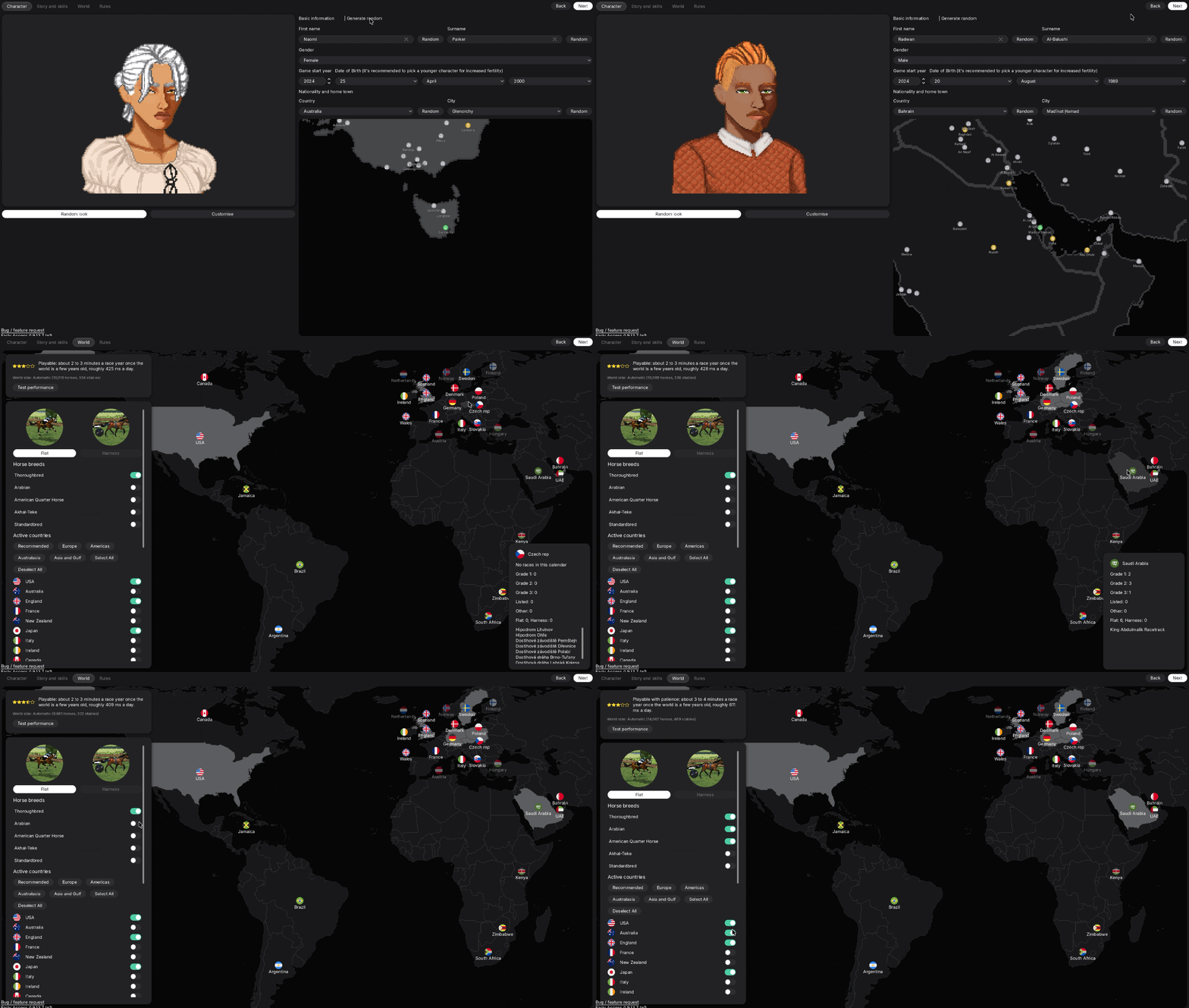
Preview of character creation and world generation
Races in the real world schedules carry breed restrictions, so the breed selector sits in the world picker, since the choice determines which races generate. The restrictions themselves are off by default, because having them on caused more confusion than it was worth, and they can be switched on from game rules for anyone who wants the schedules followed strictly. Breeds can also be selected again after a game has started, with an option to convert the breeds in an existing world. Horses stay more geographically bound with new settings covering this, and race placement for minor races is tied more closely to where horses actually are.
Every horse starts with around twelve generations of ancestry behind it, and advanced settings has an option to begin without lineages for anyone who prefers a clean slate. Pedigree carries a text based ancestor view that handles deep lineages and copies to the clipboard as a list or in spreadsheet format, with a matching descendants view alongside it. Horse names are unique forever now.

Deep lineages in the ancestor view
Custom real world horse data can be imported, including pedigrees and race histories. We built an open source scraper for this that currently gathers around 600,000 horses, and instructions are on our Discord. Horses carry a DNA seed covering coat colour, which can be ingested through a column in the custom data, so real horses can be replicated exactly, and the horse builder can import from a .horse file or be given parents to build a lineage. Imported horses can have their fans, reputation, rating and grade reset on the way in, missing ancestors can be filled with generated stand-ins, cities under the 100,000 population limit can be added through custom data settings, and horse generation can be switched off entirely so that only horses from the custom file exist. People and whole stables can be exported and imported the same way, and a horse can carry its stats across with it. The custom data side is still experimental and will have bugs.
Coats and Genetics
A coat tinting system was added, giving every horse colour five variants. Grey horses can carry white patterns such as Grey Tobiano and Grey Splash during the earlier grey stages, and the transition between grey stages is more gradual. The horse builder can pick which tint variant a horse uses.
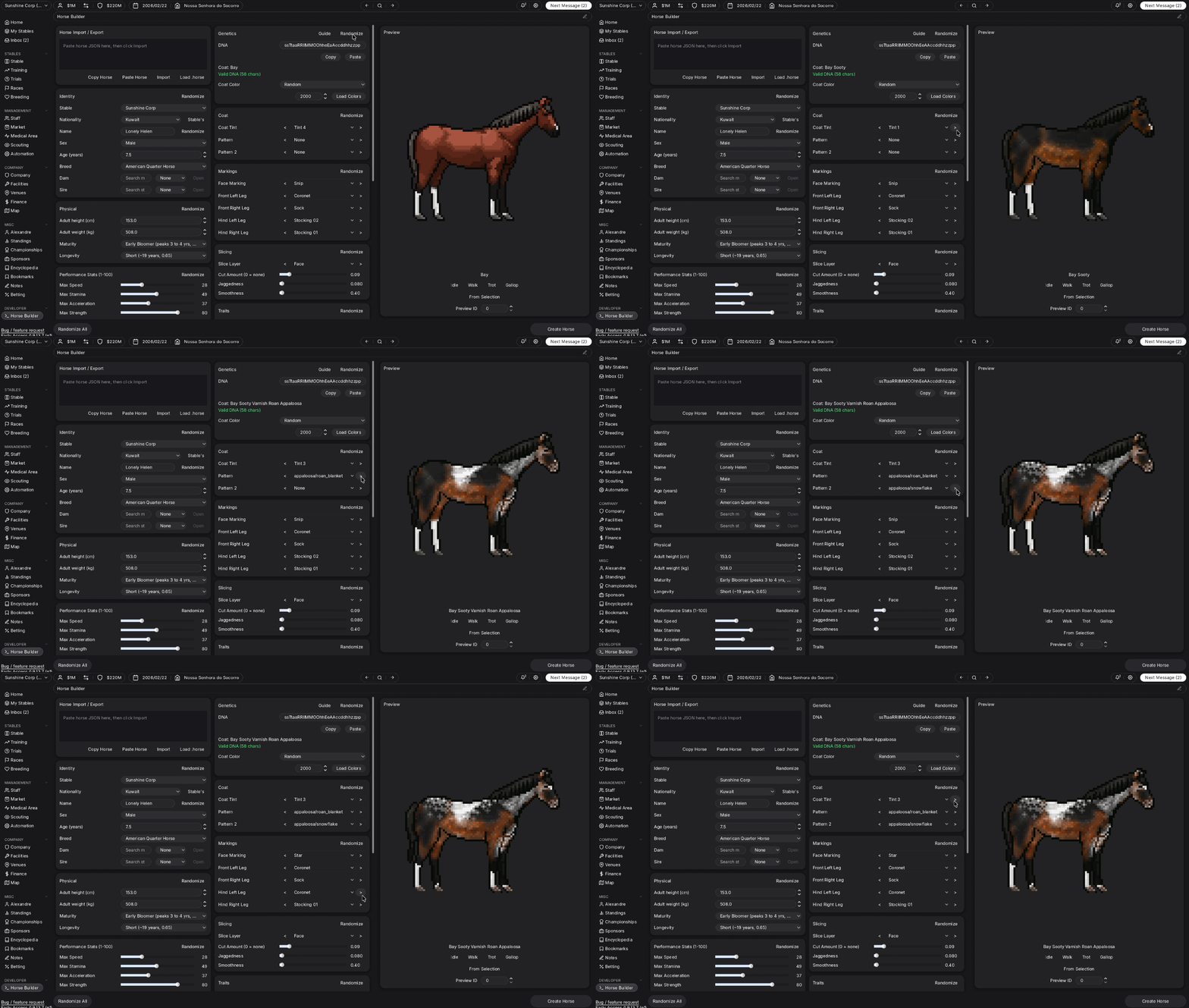
Horse builder preview
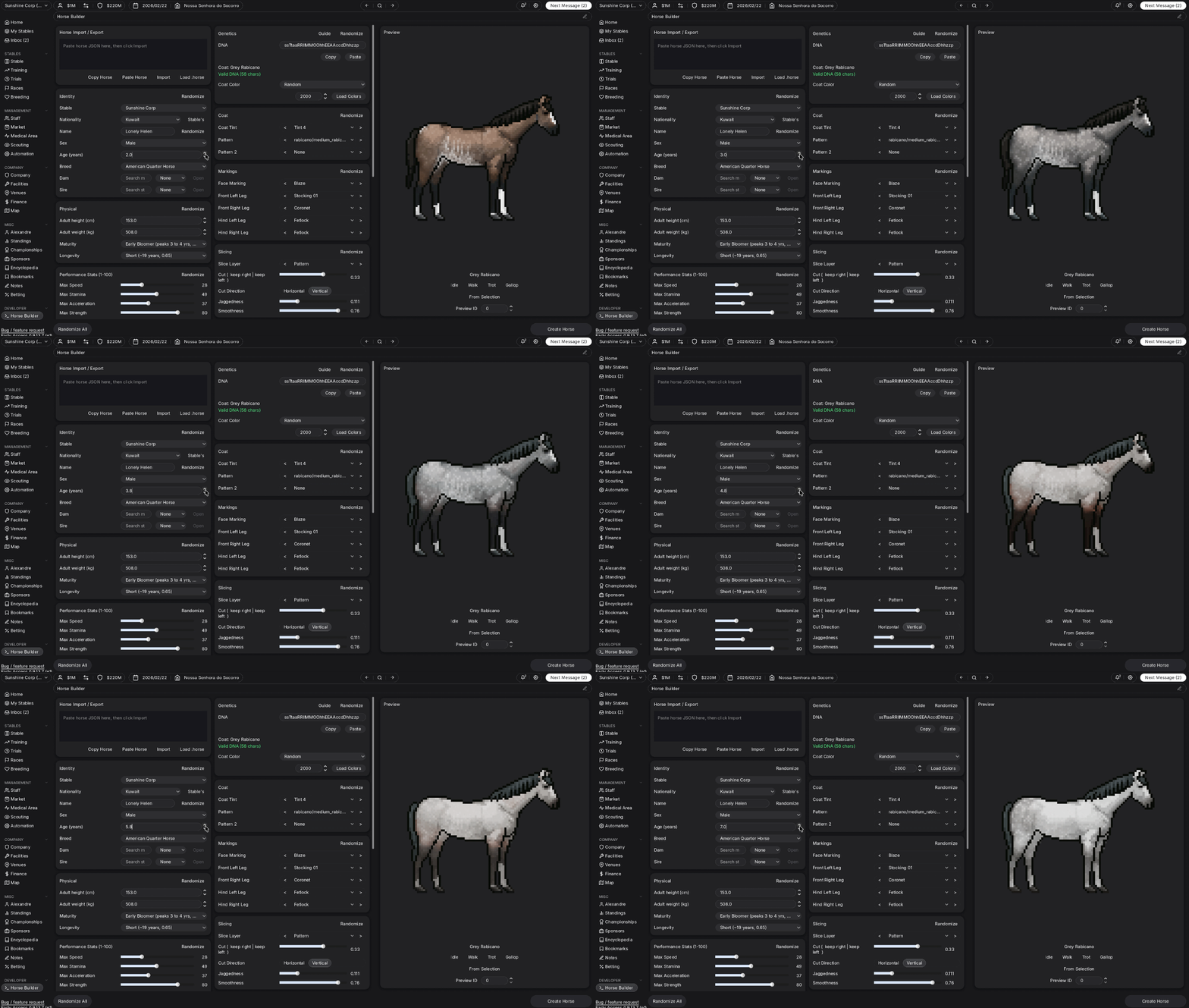
A Grey Rabicano moving through the grey stages as it ages
Coat genetics follow more realistic rules. Flaxen, sooty and splash require two copies of the gene, the appaloosa patterns were updated, and Dominant White takes priority over Grey. Smoky Cream and Sable Champagne were added as colours in their own right, and coat names in existing saves were corrected to match the underlying genetics.
Customisation settings also control what is drawn of the horse and jockey during a race, which makes it possible to build custom coats that are not horses at all. Dirt and gear can both be hidden for the same reason, and the custom coats readme was updated to match.
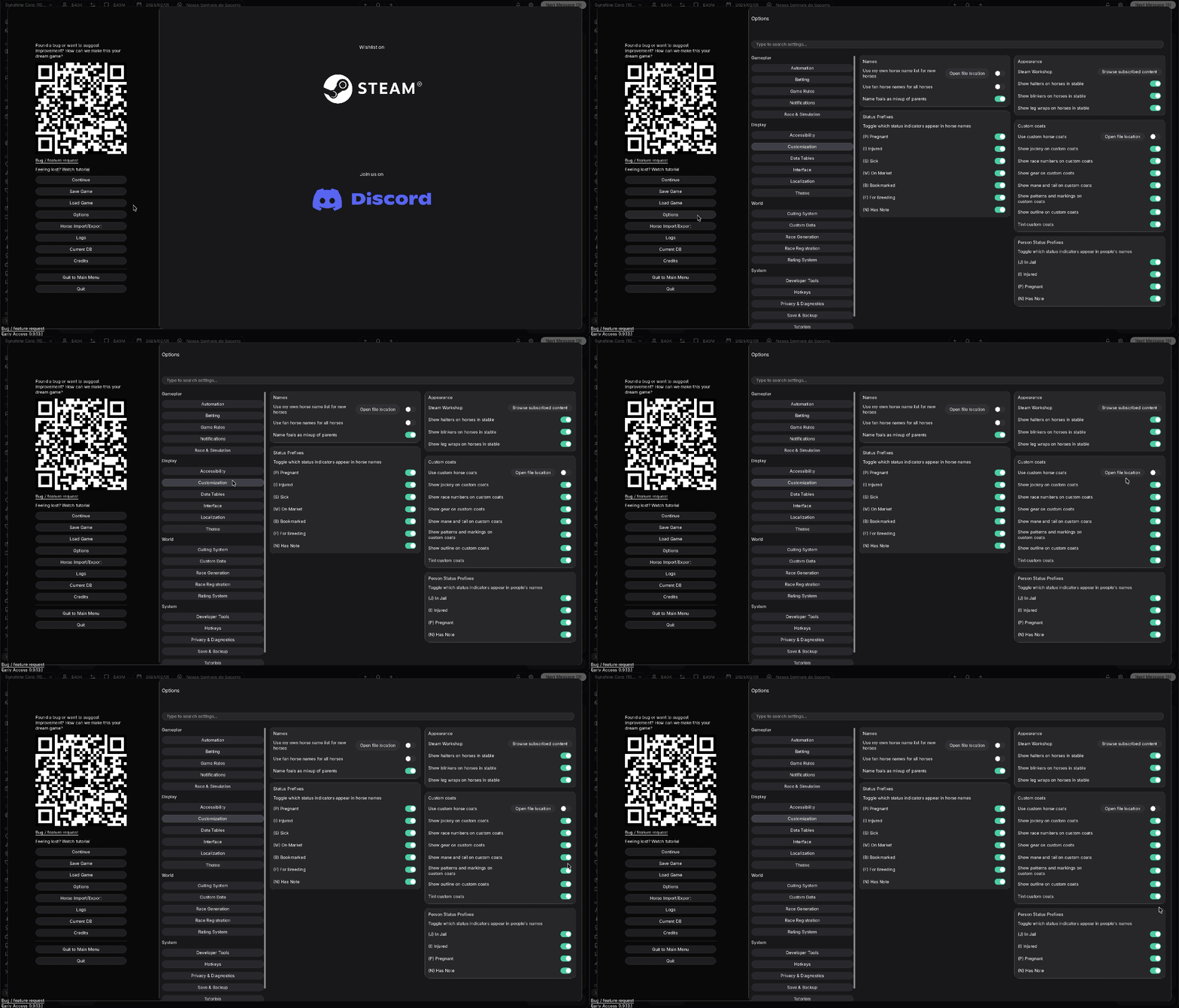
Custom coat settings
Existing horses may look slightly different after this. Every horse is assigned a tint, some coat variants are allocated differently, and the genetics changes can give a horse a different coat or pattern. The underlying genes have not changed, only how they are displayed.
Concepts
Concepts are a new way to build multi race series, so something like a Triple Crown can be created and tracked inside the game. A concept can be measured as a sweep, on points, or by aggregated time, and each race in it sends its own email. Winning a concept earns the horse a special award. Concepts live under the racing page, and the tab can be hidden from race and simulation settings.
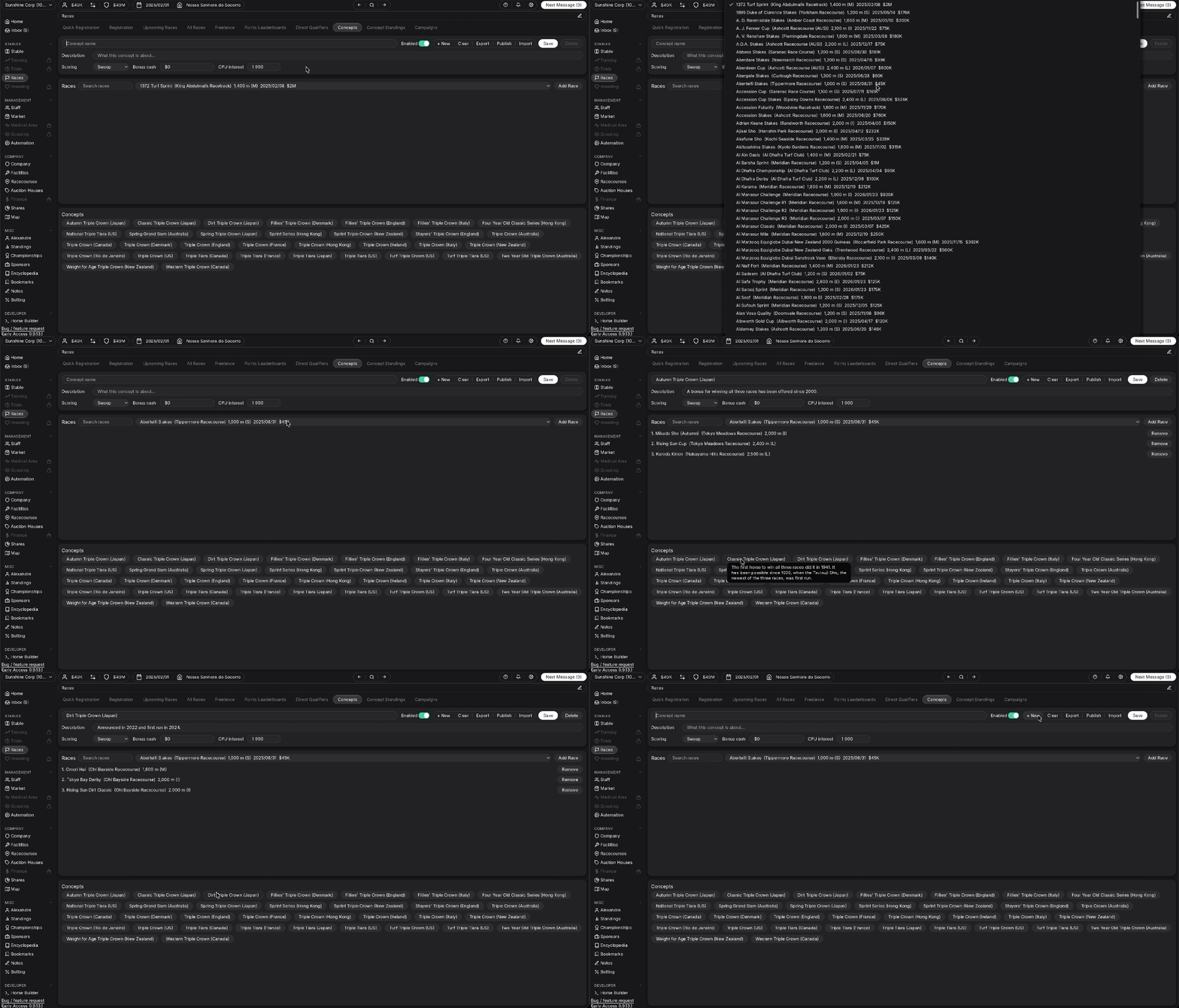
Building a concept from a set of races
Races belonging to a concept are marked as such in registration, upcoming races and standings, and past winners are listed in both race details and standings. Concept races can be isolated with a quick filter in race registration and on the all races page, and the award pages have a concept filter of their own. Concept standings spell out the requirement for each race, and entry requirements are written out on the race detail page as well.
Horses chasing a concept are not held back by the usual registration restrictions, so they can enter another race even on the same day, and winning a leg surfaces a prompt on the home screen to register for the rest. Invites arrive for the pre-gala and ahead of the final race when a horse is involved, and journalists ask questions around concepts a horse is running in.

Concept standings with the requirement for each race
A set of basic concepts ships with the game for the chosen countries, built from data created by Discord user destinysWalrus. Concepts can also be shared through the Steam Workshop alongside recurring races and auctions.
Stable Groups, Taxes and Deals
Stables can own other stables, which makes it possible to build a group under a parent stable.
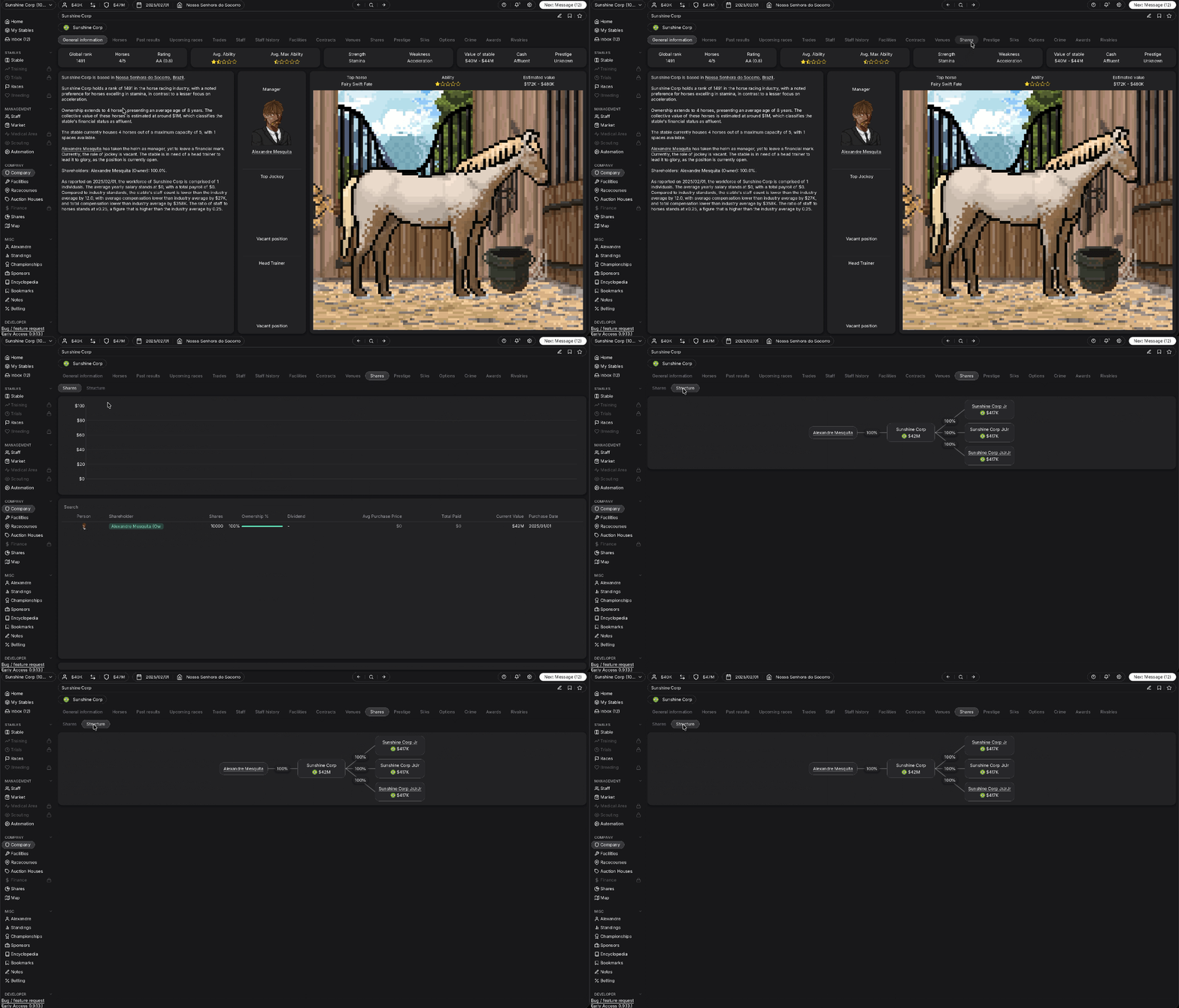
A stable group with its daughter stables
Taxes differ by country, and a stable inside a group is taxed according to its parent, so where the parent sits matters. Incorporating in a country carries an administration fee that scales against the tax level, which means the lowest tax rates come with the steepest entry cost. Ownership across a group can be viewed graphically from the share tabs on both persons and stables, and the player can change citizenship from the country page once the prerequisites are met.

Tax rates and incorporation fees by country
Deals between stables were opened up. Mergers, takeovers, turning a stable into a daughter and becoming a daughter yourself can all be proposed from the deals area under stable shares, and a merger proposal can name who ends up managing the result. Game controlled owners make the same offers in the other direction, and they found daughter stables of their own. One can also be asked to start a stable in a particular country, though they may want sponsorship money before agreeing, and they will set up in a new region on their own if races start appearing there.
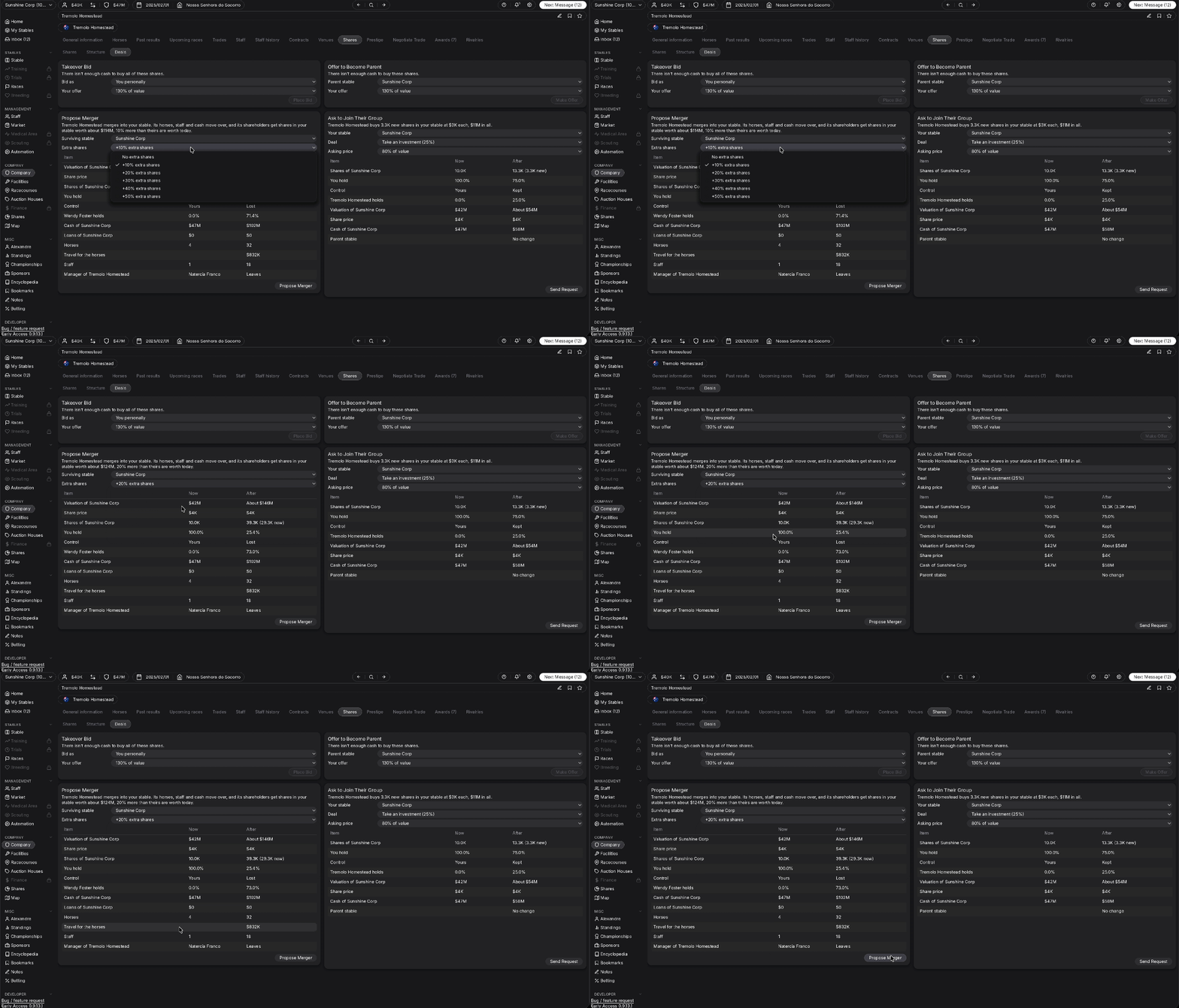
Proposing a merger from the deals area
Owning a racecourse or auction house requires a licence, with tiers covering which races can be held and how often auctions can run. Racecourses carry a purse limit per race type, on by default in settings, and building awareness as a venue is a slow business. Venue economics run on a crowd model, so filling the calendar with races across many racecourses will drive the whole operation into the red rather than print money. Prestige is shown on racecourses, the finance page offers hints while balancing, and owned venues send monthly reports. Races created at an owned venue can be given prerequisite races, so a card can be built with a path leading into it, and a venue can be sold to the shelter from the context menu or its own facility page.

Buying a racecourse licence
Crime, Courts and Dirty Tricks
Betting on a horse the player owns or rides is a criminal offence. The betting authorities issue a fine first, and continued offences lead to jail. Bribing an official to look the other way is an option, and for anyone who would rather not play with the rule there is a toggle in game rules.
Doping arrived as an illegal feed option called miracle feed, available when legal drama is switched on. Getting caught means doping charges and the authorities taking the horses away. Other stables can be sabotaged outright, and beatdowns injure the person on the receiving end.
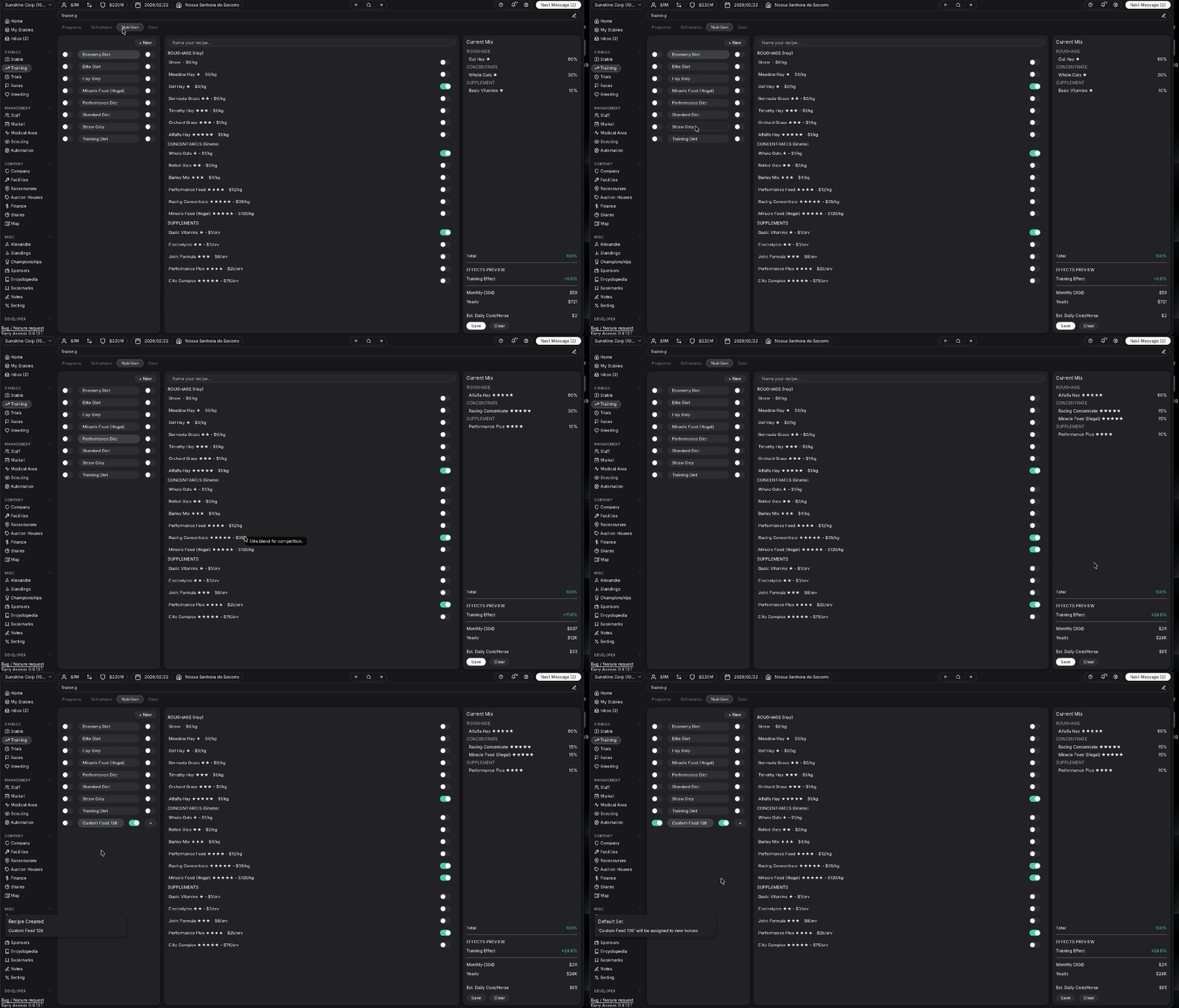
Miracle feed in the nutrition options
Secrets became a tool rather than trivia. People can be investigated for secrets, an owner can be leaned on with one during a trade, and someone can be forced to work for free under threat, which carries a risk of extortion charges. Blackmail runs both ways, since a blackmailer can be threatened back, some threats are pure bluff, and bluffing is available as a tactic. Secret lovers and children can be housed, a dating partner can be cheated on, and the secrets interface gained more types and better support through buttons and the context menu.

Investigating a person for secrets
Convictions go through a court. Cases can be settled quickly or automatically through automation settings, companies can be parties in a lawsuit, and there is a law firm subscription for anyone who ends up in court often. Court cases record where they happened, which makes fleeing to another country possible at the cost of a warrant, and a court fine can be skipped in exchange for a criminal summons. In some countries the death penalty is on the table as an outcome. The game stops at court proceedings by default, which can be turned off in settings.
The player can become supreme judge, voted in on reputation the same way the bank president is voted in on wealth, which brings the power to decide how cases are convicted and what sentence is handed down. Judges carry bias, so a good relationship with the sitting judge produces more favourable outcomes, and a judge can be bribed or blackmailed. Jail has its own events, a jailed player is fired and locked out of taking actions, and escape attempts are possible alongside bribing for early release.

Handing down a sentence as supreme judge
A karma system tracks how the world sees the player, with both being feared and being seen as a saint carrying their own benefits. The current standing is visible in the person description along with the reasons behind it, and karma drifts back towards the middle slowly. The player can also be the target of a murder plot rather than only the instigator.

Karma and the reasons behind it in the person description
Money trouble has consequences as well. Stables that do not cover negative cash within 90 days are liquidated, and a player character who cannot cover personal debt faces forced asset sales and then the glue men. Continuing as a spouse or heir is possible, and the debt follows the new character. Taxes can be left unpaid in the hope that nobody notices, which works until it does not.
Press, Rivalries and Fame
Press statements can be made from the press tab in the player profile. Backing a claim up earns recognition and fans, and journalists asking about a race can be given promises rather than safe answers, which moves both the player’s and the horse’s standing. Fans and reputation build at a slow pace, so a reputation takes a career to assemble rather than a season, and horses lose fans when results dry up.

Making a claim from the press tab
The press pays attention to more than racing. Journalists ask about stable deals, hirings and firings, and anyone buying and selling horses at speed can expect questions about the flipping. Rivalries are tracked and shown on their own tab for both horses and people, repeated meetings in the same meet generate rival emails, retirement emails name the biggest rival a horse had, and a game rule controls whether rivalries can form inside a single stable. Speaking ill of someone is available when talking to others, which shifts how the target is seen.
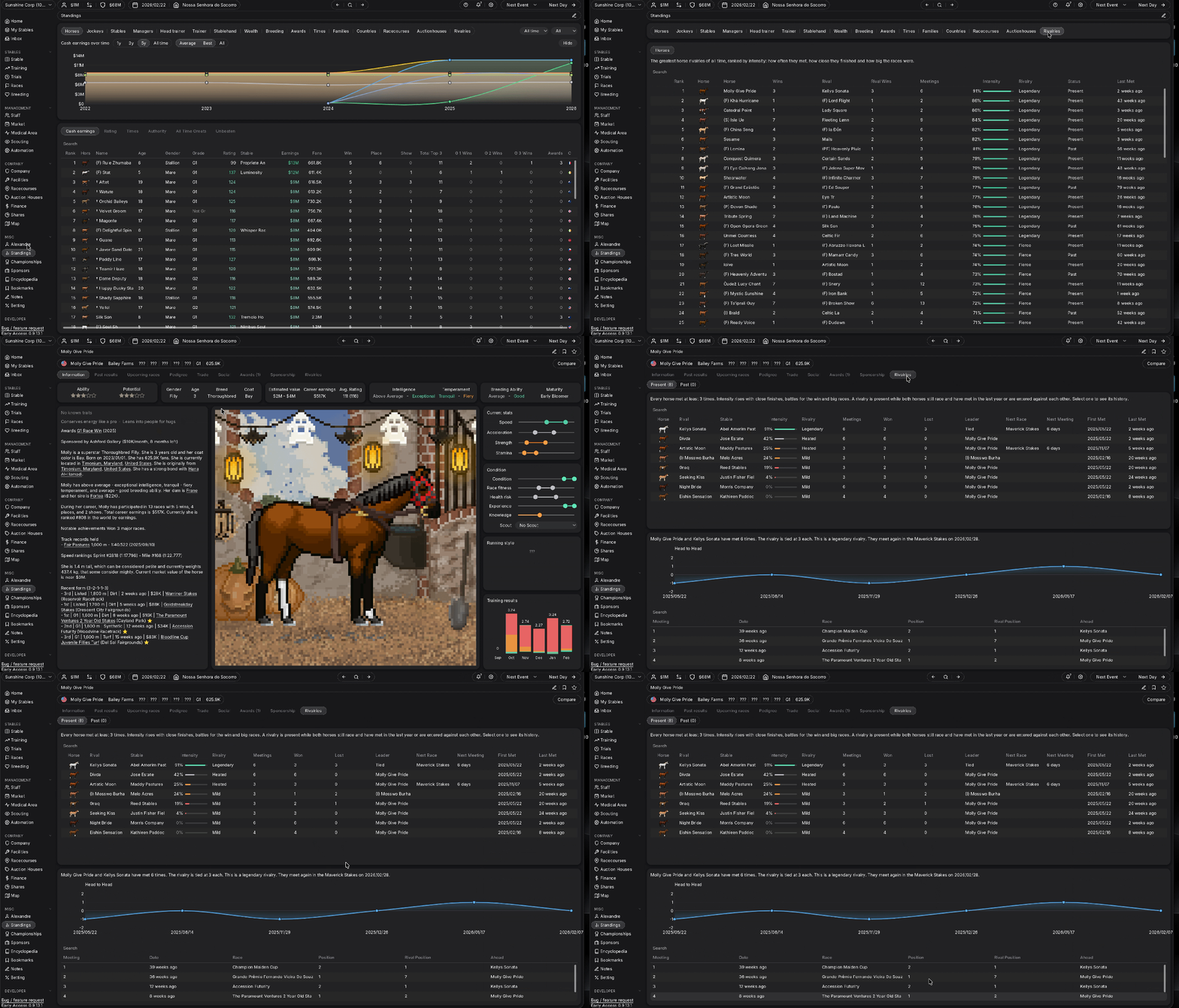
The rivalries tab of a horse
Win’s Hall of Fame was added, named after Wintarh, and a horse and a person are voted in every year. Standings gained authority rankings, an all time greats table, an unbeaten table and an award count column for horses. Merchandise deals pay out more when a larger fan base is lost, and rich strangers will not talk at all until they know the player or have been introduced somewhere like a gala.
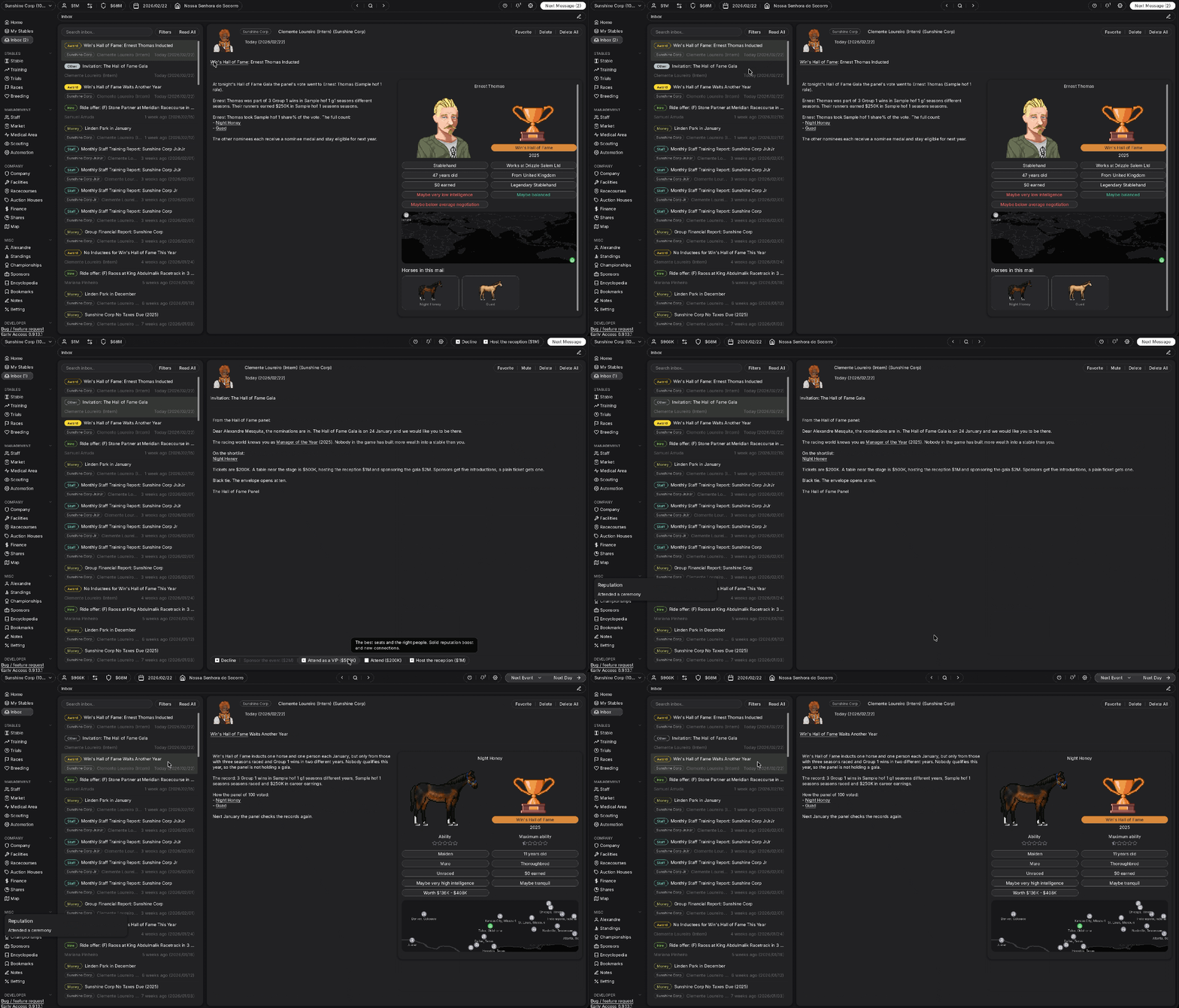
Hall of Fame news and a gala invitation in the inbox
Cities and Property
Cities have landmarks that can be donated to, such as hospitals, and the donations carry a small effect on play. The horse rescue ranch and the therapeutic riding centre can be visited from the landmark page, where a small live scene plays, and landmarks carry their own icons on the map. Travelling to a city can also be started from its detail page, and travel itself is split into short and long distance options.

City landmarks and a visit to the therapeutic riding centre
A museum can be bought as a landmark. It displays the best horses, both the player’s and the rest of the game’s, as bronze statues along with the awards they won over the years, and horses are added from the horse options or the context menu.

Statues and trophies in the racing museum
Travel plans itself more sensibly. A trip due in another country departs from wherever the player already is rather than routing home first, and the cost is calculated between those two countries, which makes a tour cheaper to run than a series of separate journeys.
Property moved beyond buying from a list. A house can be built from scratch under city properties, any property can be stayed at, and owning a home in another country means using it rather than a hotel when travelling there. Living options also carry a family time setting, where a chosen level of time with the family keeps those relationships ticking over automatically for a cost. Assets can be renamed, pets count as assets now, and there are more pets to choose from. A private island is also for sale, as requested.

Building a house under city properties
Disasters and Mortality
Disasters can strike a stable. Fires, transport crashes, roof collapses, floods, contaminated feed and riding accidents can destroy buildings and injure or kill both horses and staff. Destroyed buildings can be bought again through the facilities page, a security system lowers the chance of a disaster happening at all, and when a major fire hits there is a chance it turns out to be arson. The rate follows the difficulty slider and can also be set directly from advanced settings.

A fire and the destroyed building on the facilities page
People can be injured, take medical leave, or permanently lose the ability to ride. The player character can die in a catastrophe if a living spouse or heir survives, with play continuing through the succession screen, and outside hardcore mode there is a revival route. For major and extreme disasters the responsible company can be taken to court.
Every person carries a life left stat, shown as text in their description, and living options feed into it. The player character can die in a number of scenarios beyond disasters, and life threatening illnesses are possible. A mortality toggle is available for anyone who would rather not play with this, along with a separate toggle for family mortality.
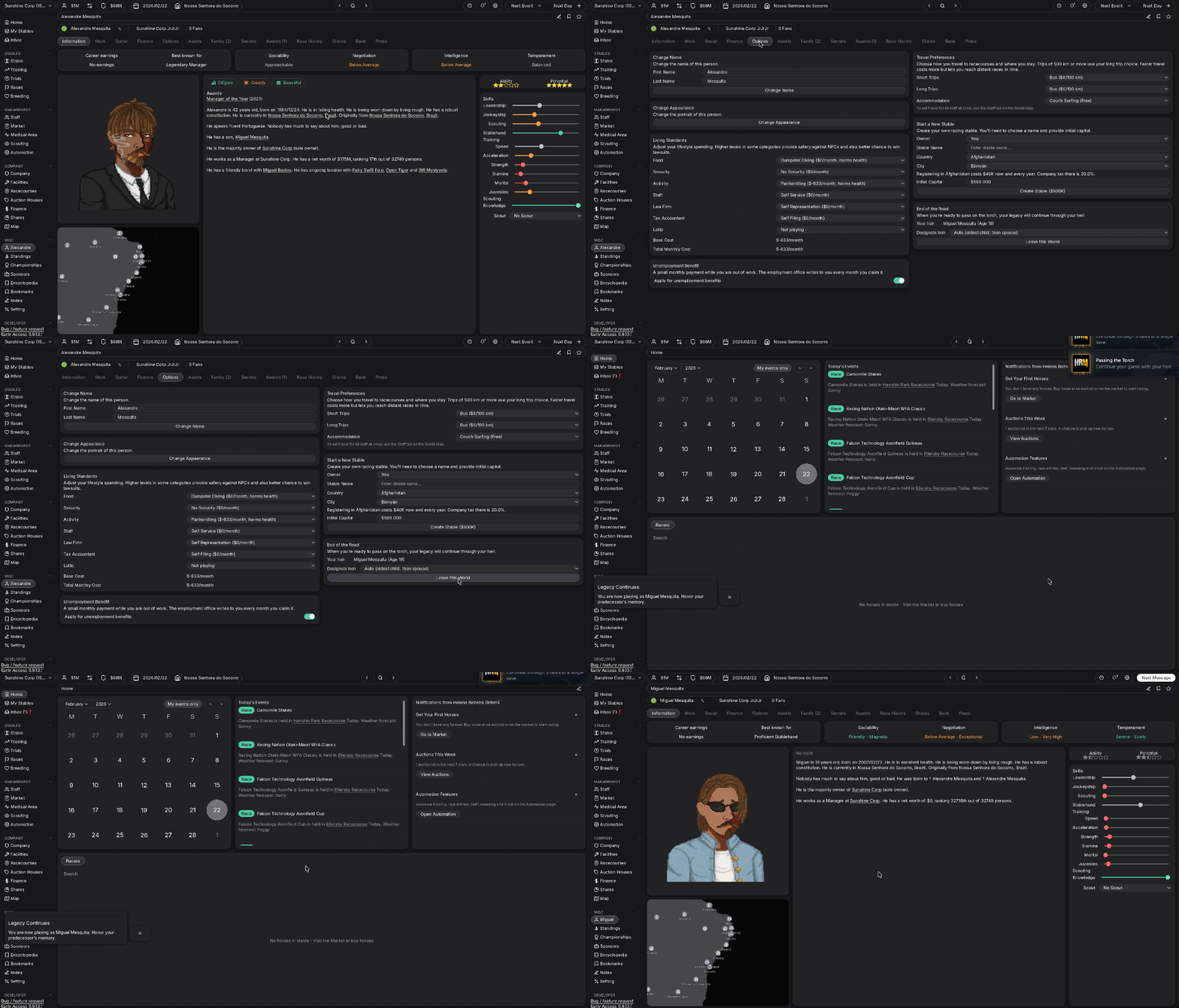
Life left in the person description
Race Engine
The race announcer system was rebuilt around a real announcer, Sketchy The Horse Guy, replacing the AI voice.
The bigger news is a new and improved race engine. It is a little slower to simulate than what came before, but the end result is a better race.
Horses no longer hold a single clean line. Every horse sways slightly from side to side, enough that a gap left by the runners in front is sometimes worth taking, and tired or hot tempered horses sway more while trotters sway half as much. Lane changes, sudden surges and bumps all cost stamina. An ordinary lane change that touches another horse is not a bump, it takes a sharp move, and in a bump both horses pay with the one that caused it paying twice over. A horse that runs into the back of another loses some acceleration for a moment rather than taking off the instant it gets clear, and a horse stuck behind a slower one eases off smoothly instead of stopping dead.

A front runner breaks clear
Starts can go wrong. A slow start leaves a horse noticeably behind the field, a stumble costs it ground just after the gate, and veering sends it sideways and slows it down. These are rare and can happen to any runner, including the player’s. Speed out of the gate follows the running style, with frontrunners and pressers away faster and the frontrunners fighting each other for early position.
Running styles were rebalanced throughout. Horses of the same style no longer push forward at the same moment, horses aiming for the same pace no longer lock to the same exact speed, and if a style is missing from a field the remaining styles spread out to cover those positions. Horses spend stamina more aggressively, a horse with enough left starts its final spurt earlier, and an unchallenged leader is no longer artificially held back. In most races between 60 and 90 percent of the field finishes having used almost all of its stamina, with sprinters and harness sprinters keeping the most in reserve.
Jockey skill carries real weight now. It governs collision avoidance, getting out of a box, how quickly a horse recovers from a bump, and when a chase begins. A blocked jockey looks further down the track for a free lane, and better jockeys aim for the middle of the track on the home stretch rather than the edges. The gap between the best and worst jockeys works out at roughly three percent of a horse’s pace in either direction from an average rider.
Distance preference now behaves differently in each direction. A horse dropped below its preferred distance uses less stamina but runs slower, while a horse stepped up above it holds its speed and runs a little faster through the race before risking running empty near the line. Strength, stamina and acceleration all matter more than they did, harness races judge preferred distance by the actual race length, and harness worlds name their distance bands Short, Standard, Long, Extra Long and Marathon.
The numbers we are aiming at are these. The faster horse wins something like 40 to 50 percent of races, the top star rated horse wins 30 to 37 percent, horses at their preferred distance do better than those outside it, and a perfect horse can beat the world record by half a percent to one and a half percent.
Watched races and simulated races now produce the same result. Stamina use, race timing and how the field is set up all match, and races play out identically at every simulation quality setting. On Windows and macOS a watched offline race also runs considerably faster. Online races and Linux still use the older engine.
Racing and Riding
Races can be run at whatever level of involvement suits. A riding difficulty setting offers casual, normal and hardcore modes alongside a custom option, which can be set even easier than casual. The game asks which mode is wanted when a new game starts, and the choice can be changed later under race and simulation settings. It surprised us how many people play this game casually, and the setting exists because of that.
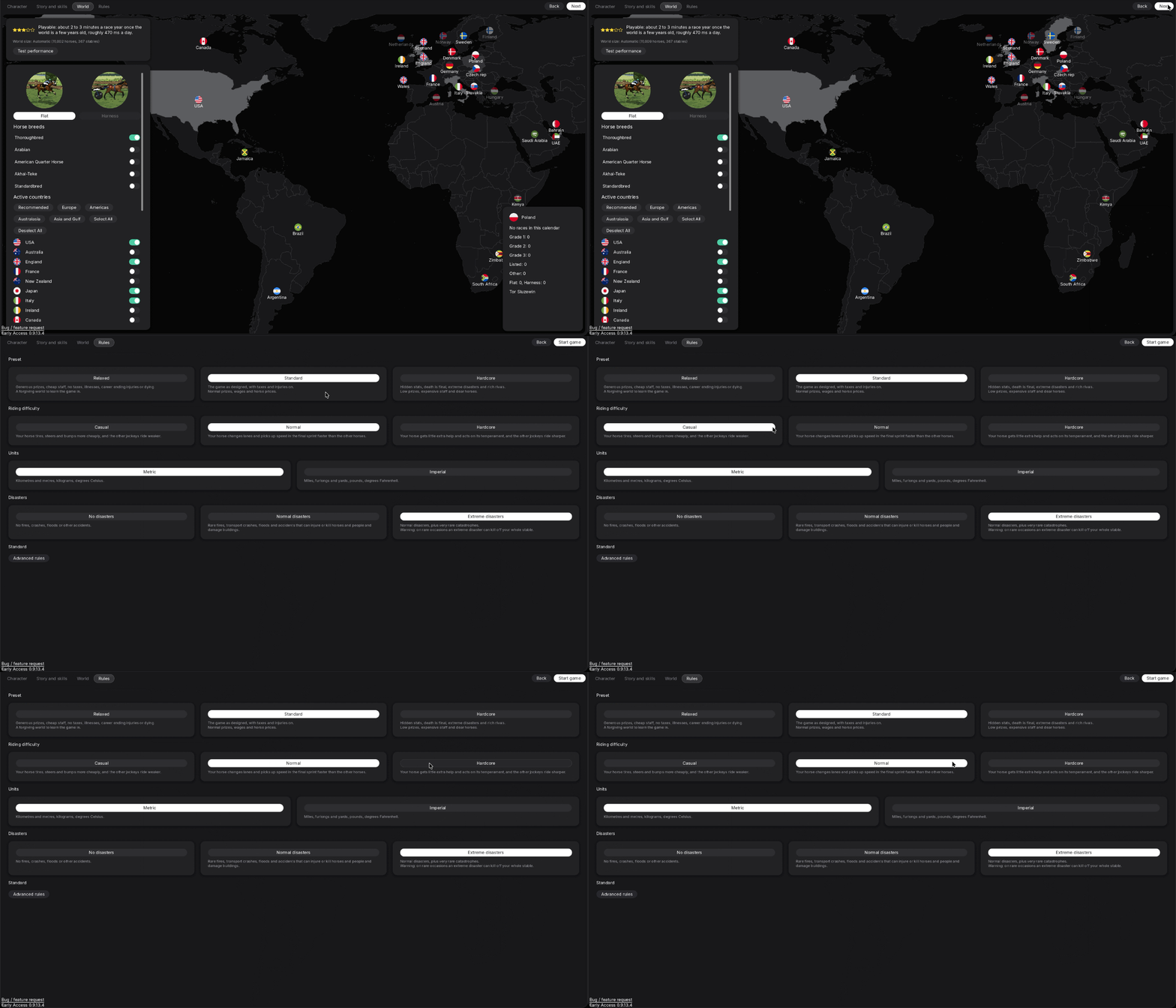
Choosing a race mode when starting a new game
Target speed sensitivity controls how fast the accelerate and decelerate buttons move the target speed. A help timer can be switched on for the start. The skip button is back and works on a hold, with the game taking over the horse to finish the race if the player was riding. The speed bar fills relative to the top speed the horse can actually reach at that moment, which moves around during a race, and the running order animates as it changes so the shifts are easier to follow.
A horse that interferes with another can be placed behind it by a Stewards’ Enquiry, which can be turned off in race and simulation settings, though online races always hold one.
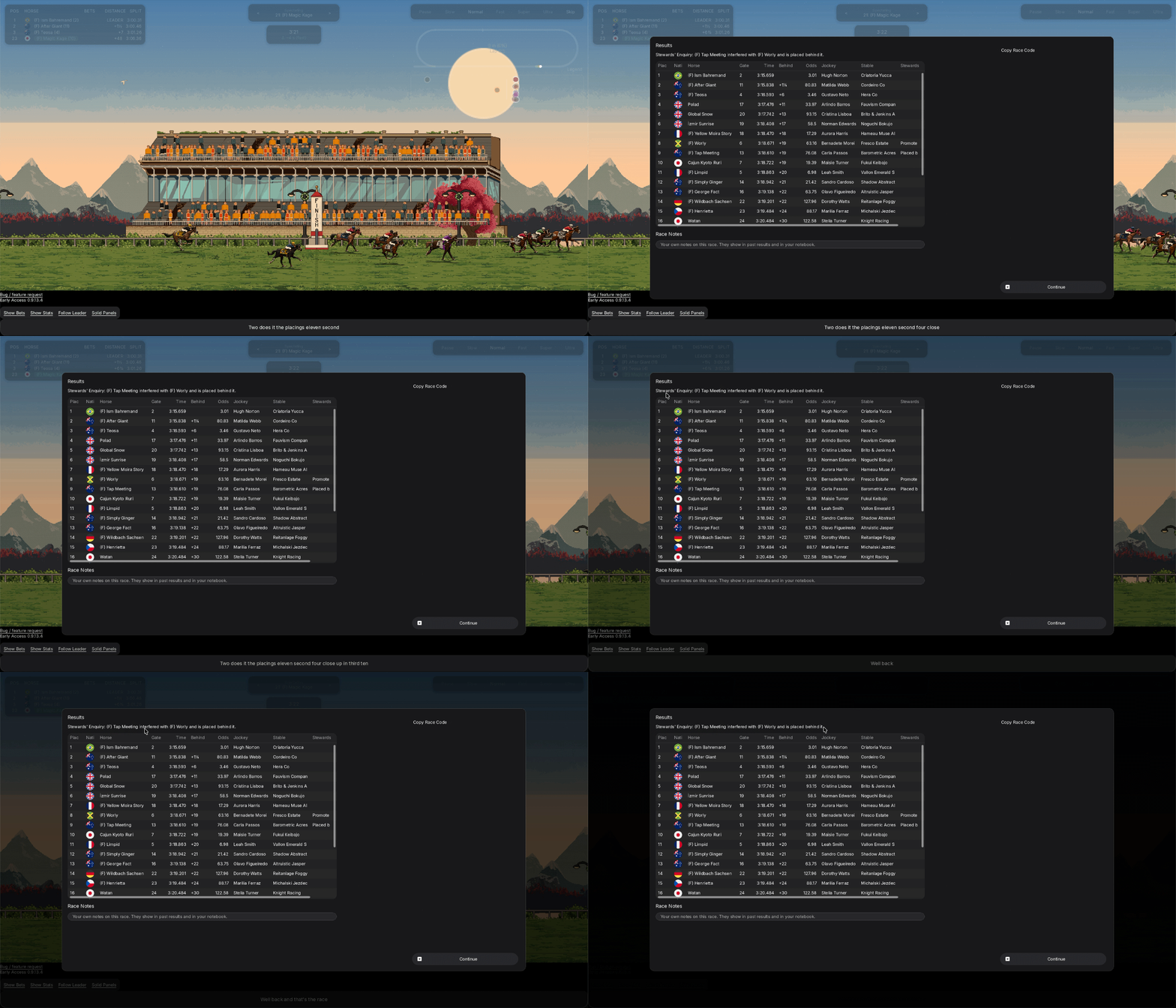
A Stewards’ Enquiry reviewing an incident
Race replays were added. Settings for them live under save and backup, and both the race result view and past result tables carry buttons to replay a race or copy a replay code that can be handed to someone else. Replays can also be published to the Steam Workshop, privately if preferred, which makes them easy to keep long term and to browse and watch from the pause menu. Notes can be written after a race and they show up in past result tables.
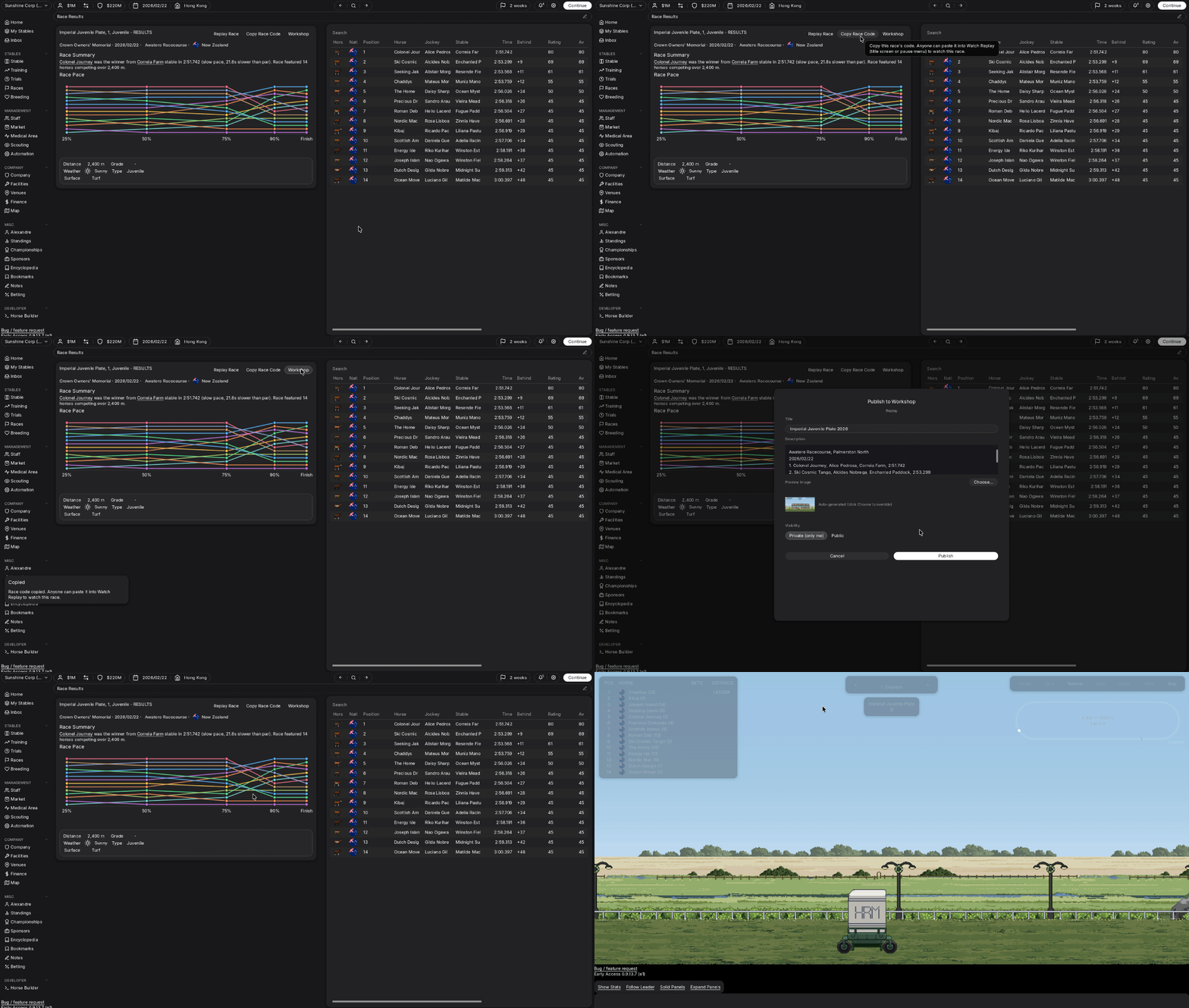
Copying the replay code, publishing to Workshop and replaying a race
A new lighting and weather system drives the look of the track, and races can run at different parts of the day. Racetracks come in four different looks, chosen under racetrack and facilities, and an old school visual filter can be switched on from race and simulation settings for anyone who wants a period feel.
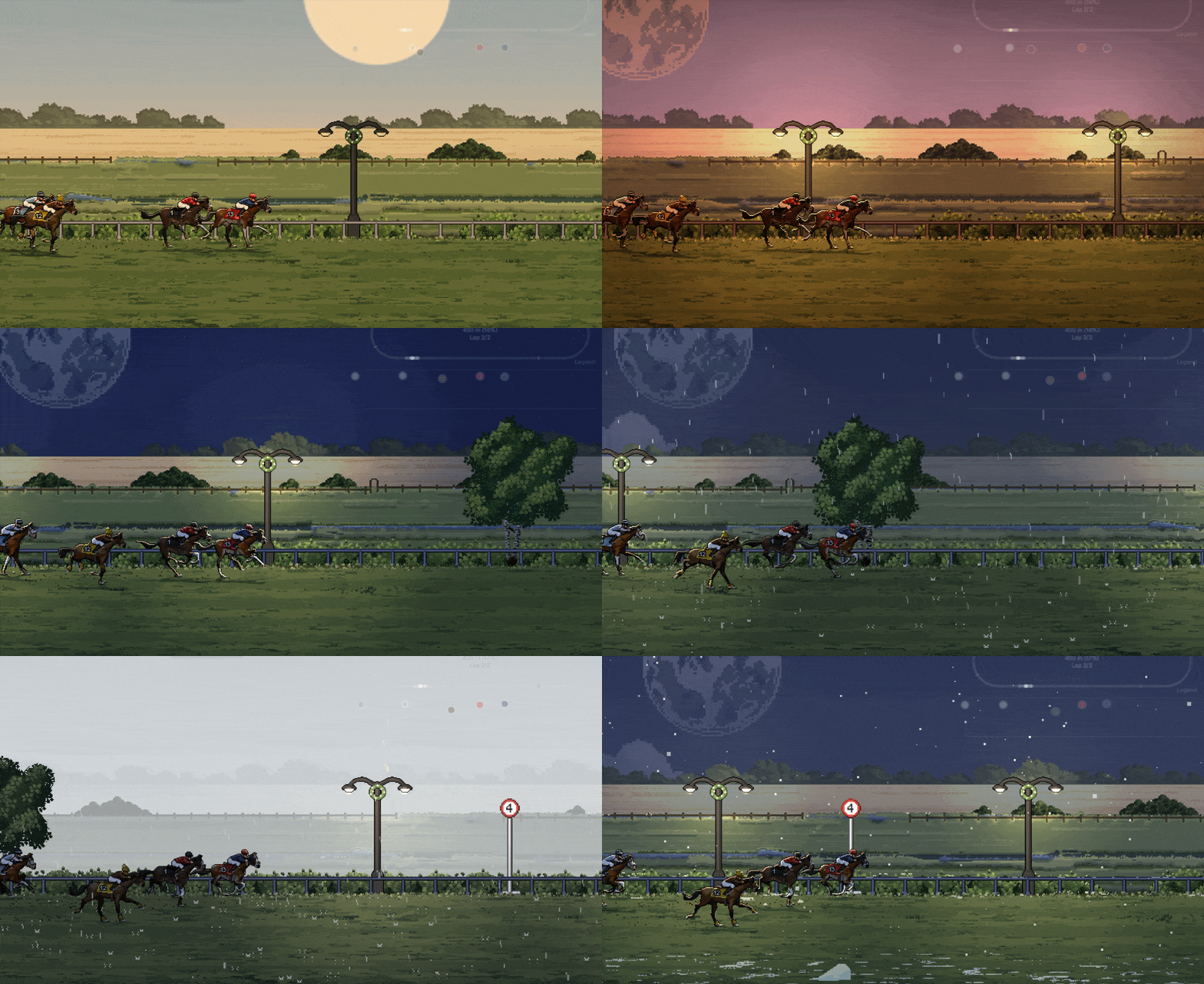
The same race at different times of day and in different weather
For taking the reins there is an optional position hint overlay that suggests where to run based on the horse’s running style. Speed and stamina bars above horses can be hidden, the live race shows how much track is left along with the race’s grade, name and purse, and every racetrack has a universal placeholder grandstand. The speed and stamina indicators sit above the horses so nothing blocks them, and the pace chart after a race highlights the player’s own runners.

The position hint overlay while taking the reins
Horses have equipment preferences, and the jockey comments on how the gear suited the horse after the race, with a button in the report to add or remove the piece straight away. A gear tab was added to the horse profile, gear itself is customisable with a simplified picker on first open and advanced settings behind it, and a setting makes gear purely cosmetic for anyone who would rather it not affect play. Winning a listed race or above puts a winners blanket on the horse in its profile for a day, and stables can design their own custom blanket in the silks tab of the company page.

The jockey’s gear comment and the button to change it straight away
Race preview can be shown as a formbook rather than a table, and race times can be displayed five different ways for both flat and harness, including per kilometre and per mile with the drop minute format. A staff comment in the preview says how the horse feels going in. A horse can be entered by hand into several races on the same day as long as they share a location, betting odds were reworked so the market forms more realistically, and for G1 races the number draw arrives by email while other races draw silently 48 hours before. Race and auction previews and results have their own panels, eligible horses can be added to an auction from there, result pages show how far behind each horse finished, and race registration has a condition quick filter.
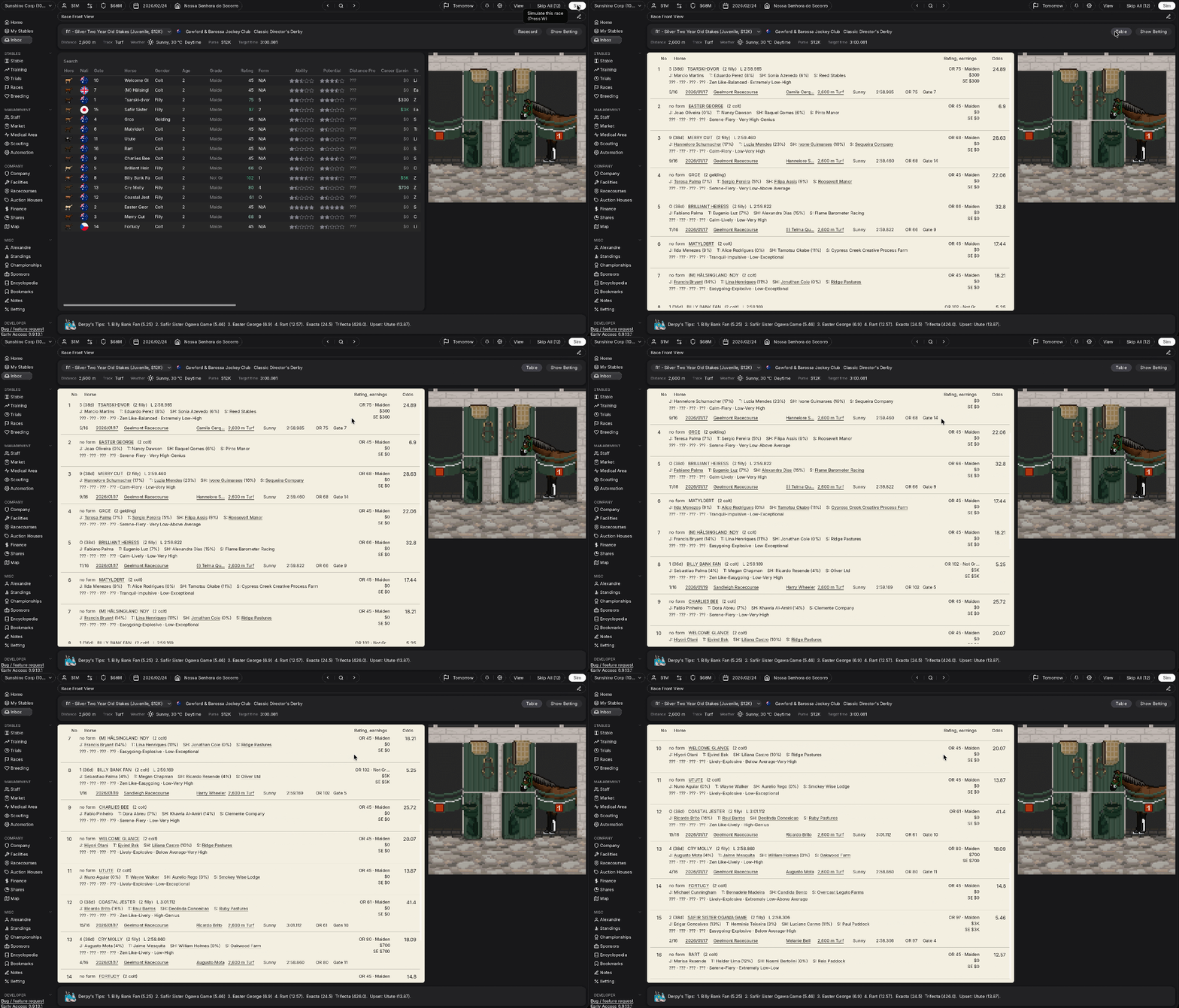
Race preview as a formbook
Anyone with telemetry switched on is asked for optional feedback after a live race on how it felt, which helps us separate the good races from the bad ones.
Training, Breeding and Horse Care
All horses now have race fitness, and a horse in good fitness gets a small boost that can push its stats slightly past their natural maximum. Fitness builds through racing as well as training. The training page carries projection graphs for fitness, health risk and condition, so the shape of a programme can be read before committing to it, and a matrix table in the horse training tab lays out everything that feeds into training. Hard training costs more condition, manual training recovers some condition daily, and the balance between automatic and manual training was adjusted.

Fitness, health risk and condition projections while changing a programme
Sprint and pacing work moves a horse’s distance preference more decisively without draining its best band, and trainer skill governs how quickly that shift happens. The training page is also where the surface and distance for automatic race registration are set, and individual jockeys, trainers and stablehands can be locked so automatic assignment leaves them alone.
Horses get dirty now, from racing, from training and from being horses. Grooming is done from the horse profile, assigned caretakers handle it automatically, and caretaker skill determines how clean a horse can get. Picking out the hooves during grooming raises shoe quality and durability slightly. Anyone who would rather not groom by hand can turn on automatic grooming in personal automation settings, shoeing done personally can be automated the same way, and three new interactions with horses were added alongside all this.
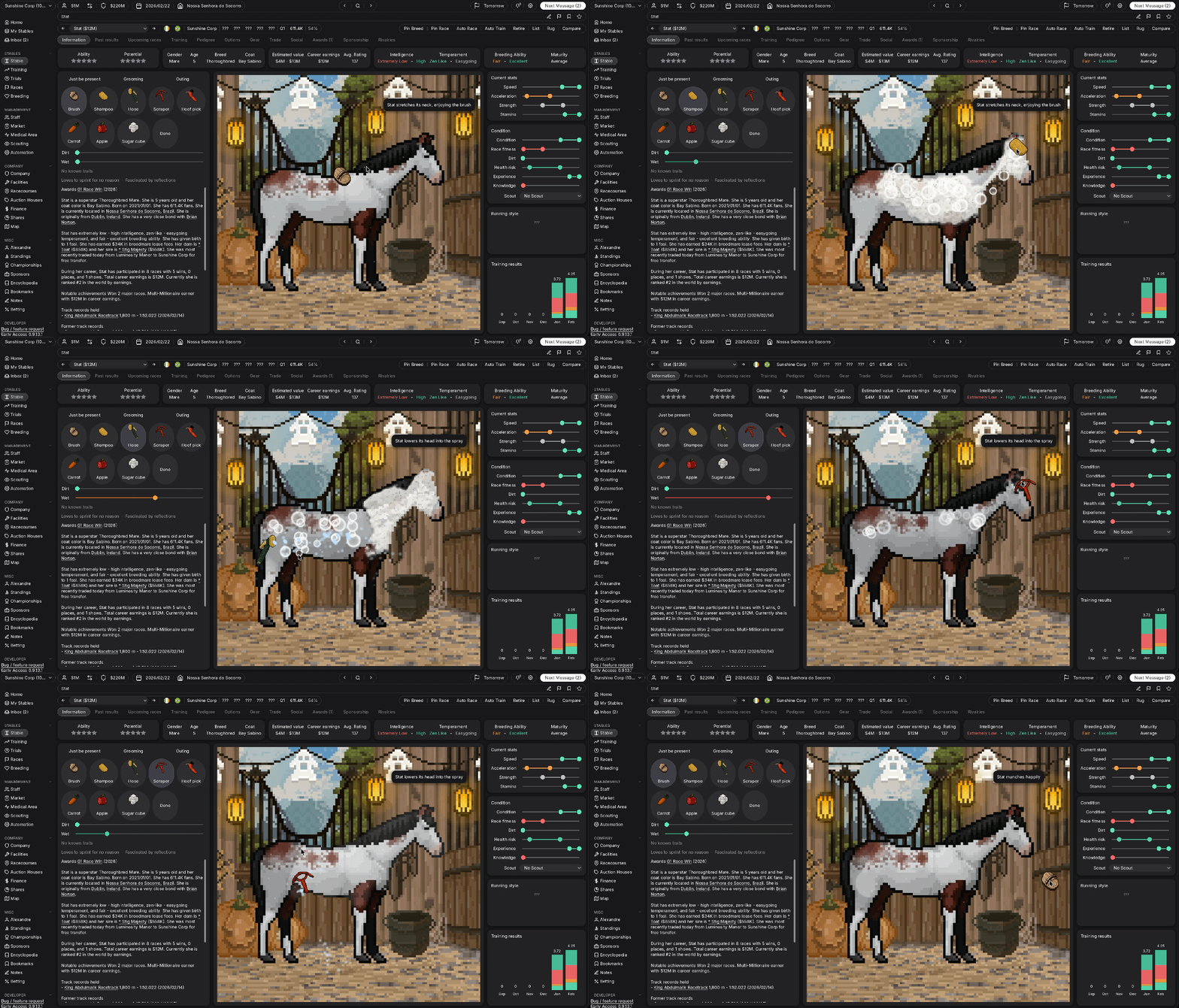
Grooming a horse
Neglect has consequences. Unclean horses attract an inspection from the Horse Welfare Authorities, and continued neglect leads to jail with the horses seized. Retired horses keep their caretaker, so they stay part of the system, and a paddock can be bought where they stroll around and can be watched from the retired tab. Horses also pass personality traits to each other, governed by the same game rule toggle that controls whether traits are infectious among staff.

Retired horses strolling in the paddock
On the breeding side, a stallion can be starred in its profile and automation set so mares of a chosen age breed with it. Bulk breeding has no pool cap and carries a stable filter, the breed all button shows what the whole batch will cost before it runs, breeding automation works across owned stables rather than one at a time, and a foal born email offers buttons to repeat that breeding or every possible breeding. Hovering over the inbreeding level lists the horses in the lineage behind it, and there is a new birth option that combines natural birth with aging on August 1st.
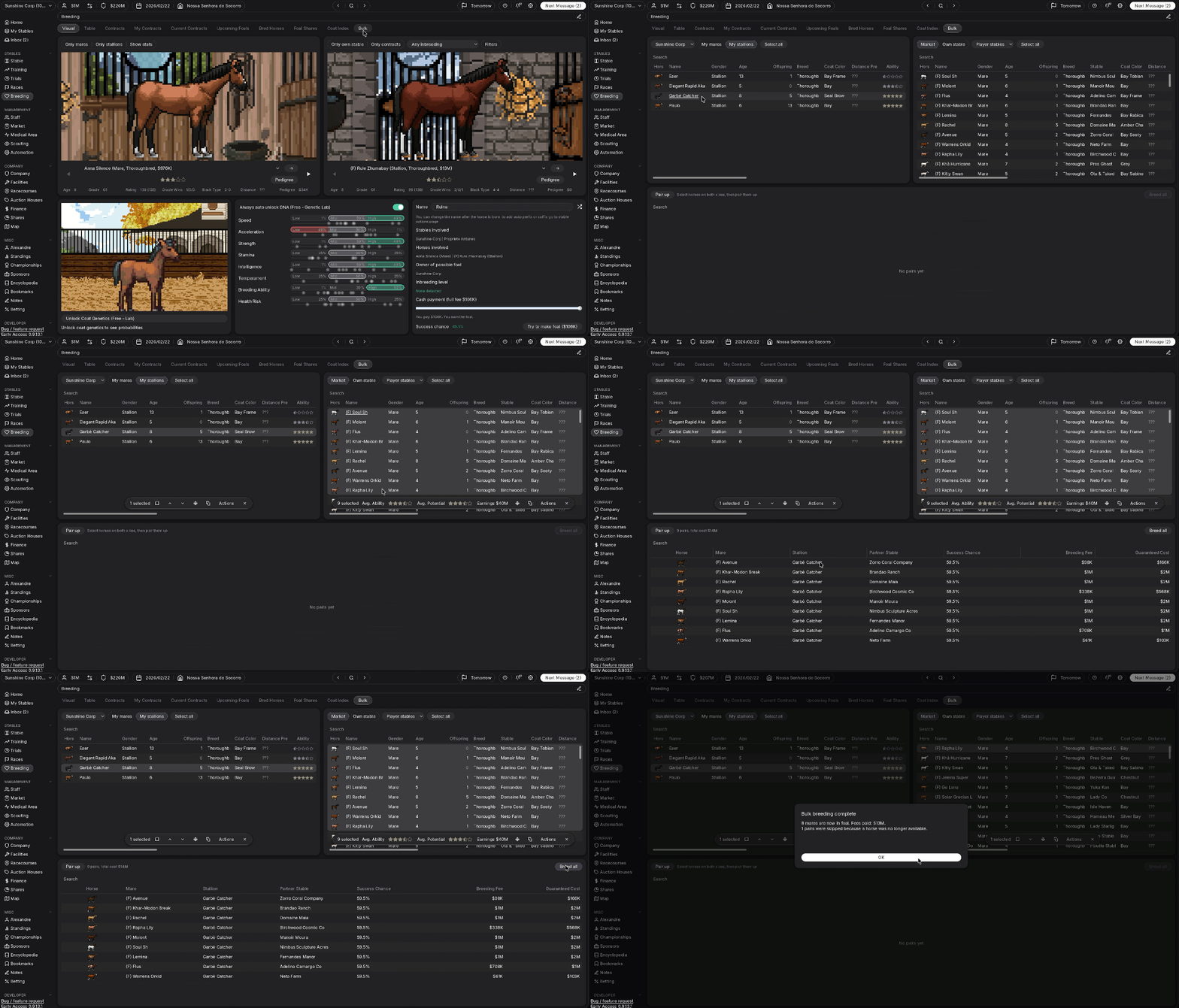
Bulk breeding a group of mares with a starred stallion
Knowledge, Scouting and Insights
An insights feature was added to the scouting page, where horses can be compared at scale on a scatter plot. Groups can be dragged over and worked with through the context menu the same way as in data tables, and there is a separate comparison tool for looking at a smaller set side by side. Scouting assignments have more threshold options and can be filtered by travel time, by whether a person is employed, or by offspring of a particular horse. Scouting knowledge decays monthly, so information needs upkeep.

Making a quick offer on insight page
Knowledge itself carries more weight. Potential on horses between zero and two years old is heavily jittered, up to 80% for an unscouted horse, and the younger the horse the more the number moves. Ability is jittered as well but less, since it is more observable. Low knowledge shows as grey in the interface, progress bars for unknown values are kept legible, the world starts less scouted, and all knowledge related settings sit in their own category. Times are visible outside hardcore mode as well, for anyone who would rather read a horse through the clock. A new manager starts with some knowledge of the stable’s horses, 10% for every 30 days the stable has owned the horse, up to 80%.

Jittered values on a young horse as knowledge grows
Star ratings lean heavily on speed, which gives a more honest reading of how a horse should run, and the same number drives race entries, odds, tipsters, race analysis and what game controlled stables decide to do. The valuation model was rebalanced around this, and valuation of imported horses was reworked so that ability has little effect on young horses, since a precise valuation would otherwise leak what the horse is capable of. Talking to people and following award winners adds a little knowledge about them, and the same applies to horses.
Reputation cuts both ways. Once a stable is well known, game controlled stables want a premium to part with their best horses, and staff ask for more money. The difficulty slider controls how much extra they want.
Economy, Shares and Staff
Vets and farriers were removed as job roles and turned into subscriptions. Neither role had an active part to play, and in practice stables do not keep their own vet or farrier. Staff salaries were rebalanced around this, so most roles sit at modest pay while the very best people in the world can command enormous sums. Trainers and stablehands have their own standings pages, with a yearly award for both.
The share system moved to treasury shares rather than a public float, and IPO buyers are real people rather than an abstract market. Existing shareholders get a fourteen day window to take part in an IPO or secondary offering at a ten percent discount. Shares can be bought one at a time or in bulk across several people through the context menu, game controlled owners can sell shares back to the stable, and a stable needs two years before an IPO is possible. Control follows the largest shareholder even when that holding falls short of half the company. Horse values sit at a lower scale with a setting to adjust it, and taxes are progressive, which makes the late game harder.

Buying shares from several shareholders at once
Savings accounts were added, so both the player and a stable can put money in the bank and earn interest on it. A friendly bank president means better terms and a hostile one means worse, and the investment banking facility has a larger effect on the rate. As bank president the rate itself can be set, though cutting it too far invites a lawsuit.
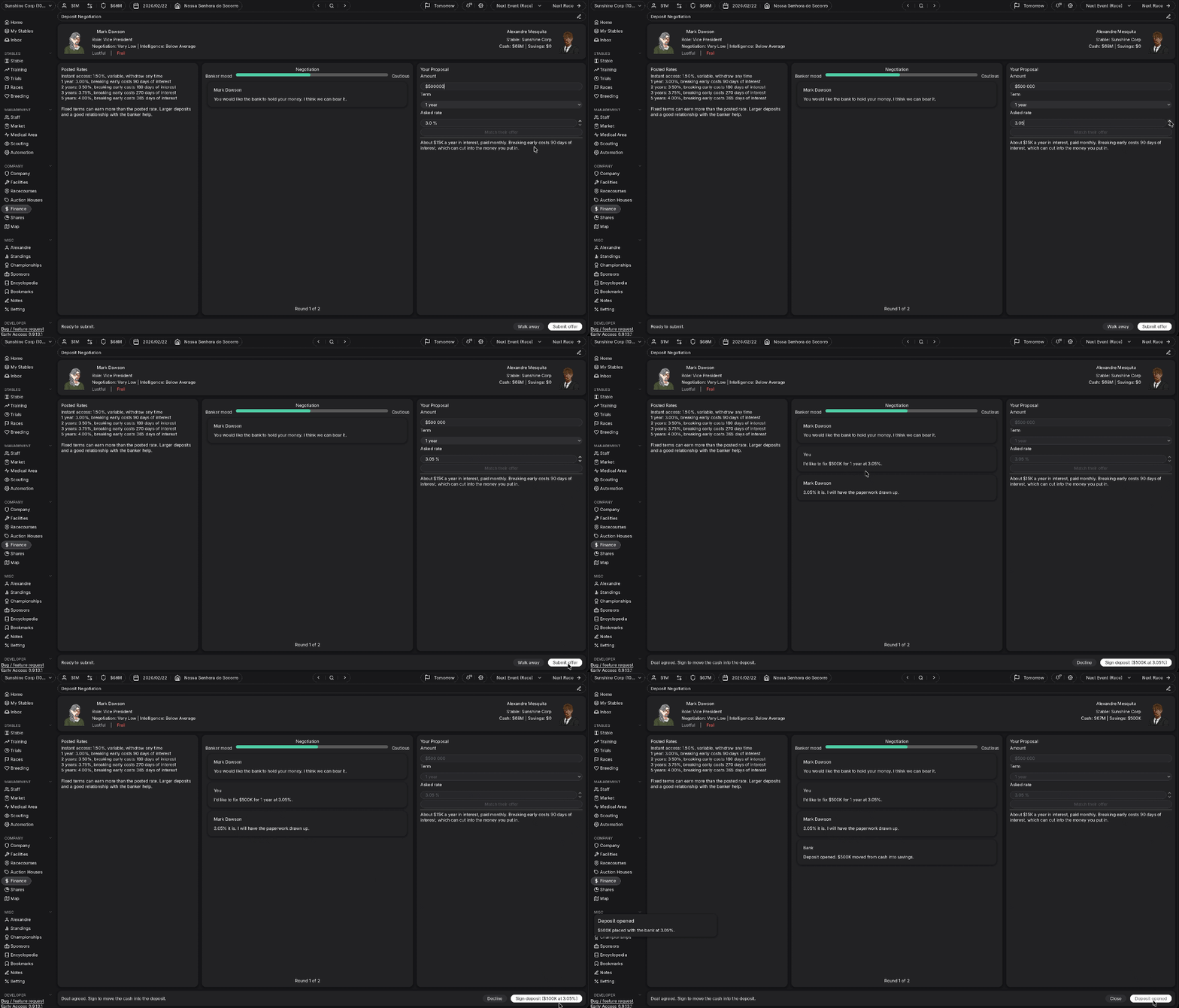
Opening a savings account with the bank
Insurance behaves more like the real thing and will try to avoid paying out. Chronic conditions stay chronic and carry a monthly cost, interest rates went up, and the maximum loan a bank is willing to give was reworked. Manager budgets are a hard limit, with a warning the first time one is exceeded and dismissal the second, and letting a stable’s valuation fall far enough brings a warning of its own or, in bad cases, immediate dismissal. G1 invites and some galas are charged to the stable account rather than the personal one. An owner can write a win percentage into their own employment contract, and an heir over sixteen picks up the player’s manager roles automatically when the player leaves.
Trades record the value of a horse at the moment an offer is made, so a seller who sees the price climb afterwards declines politely instead of taking offence. When staff come to talk it plays out as a negotiation rather than a yes or no, and an employee who fails to pay what they owe sends an email that can be answered by suing them, letting it go, or telling them where to go. When money is tight a pay cut can be taken in exchange for equity, and staff can be asked to do the same. A setting can prevent staff resigning entirely for anyone who would rather not deal with it.

A staff member comes to talk and it turns into a negotiation
Sponsor payouts were rebalanced and lowered overall, and sponsors have their own page in the navigation bar so jockeys can see them too. Jockey reputation and fame were reworked, which makes the climb to top jockey harder, and the world starts with jockey reputation and fame already seeded. Freelance rides run on a ladder, where five wins at one grade open the next one up, so a new jockey builds a name before the big races become available, and a toggle turns the ladder off for anyone who would rather play without it. An injured jockey stays assigned to their horses with a freelance rider covering in the meantime, so nothing needs reassigning once they recover. The freelance rides table shows every available offer with fewer clashes between them, and both freelance and stable rides can be cancelled from upcoming races through the context menu. Pregnant jockeys do not ride, with a toggle in settings for anyone who disagrees.
Moving things between stables got easier across the board. Staff can be transferred between stables, horses can be moved between the player’s own stables and family stables, venues can be transferred between owned stables, whole stables can be passed between family members, and family stables can be created and edited directly. A family stable can also be hidden from the top dropdown, and the family then runs it themselves.
Horses and people both have fan counts, which feed into valuations. Manager reputation is driven by wealth creation, and a wealth built tab in manager standings ranks career wealth created. Unemployment benefits exist for anyone between jobs, and housing runs from a slum room at 7,000 a year up through rentable apartments. A racecourse’s past races list shows the betting commission each race earned, with racecourse finances grouping that commission by day.
Tutorials, Encyclopedia and Controller Support
The tutorial system was rebuilt as a free roaming system, so the game can be interacted with while a tutorial is running rather than locking everything down. Multiple new tutorials cover individual pages, and there is a new tutorial video with the in game links pointing at it. The tutorials are voiced, with the voice work done by Rattle, and tutorial emails are more direct with a large call to action button.

A voiced tutorial running while the game stays playable
The encyclopedia grew into something closer to a reference. There are basics and starter pages for anyone new to the sport, articles link terms through to other articles so one page leads to the next, and missing entries were written while older ones were corrected. Breeds have their own section under breeding, including ones invented in a save, which can be renamed and get an encyclopedia entry of their own. Searching from the command bar shows a snippet of the entry, the whole interface was reworked to match the rest of the game, and both single articles and the full encyclopedia can be copied out for use with a language model.

Navigating through encyclopedia
A first version of controller support is in. It works best with a PS5 controller and should make the Steam Deck a better experience, built on a navigation hierarchy meant to keep the main loops feeling natural. There will still be bugs in it. Buttons with hotkeys carry button emoji indicators, which can be turned off in interface settings, and buttons follow a consistent layout with positive options on the right and negative on the left. Arrow keys no longer switch the game into controller mode, with a setting for anyone who wants that behaviour. We are currently working on making the Deck experience smoother.

Navigating the game with a PS5 controller
Interface, Tables and Quality of Life
Tables reached their third version. Selecting a row surfaces an action button at the bottom, rows can be selected by dragging across them, changing one dropdown in a selection changes all of them, hovering a row and pressing F freezes it to the top, and the action bar reports totals for whatever is selected. Table sorting is stored per save, column tooltips explain what each one holds, relative dates show the exact date on hover, and every column from the stable page is available as a custom tab column.
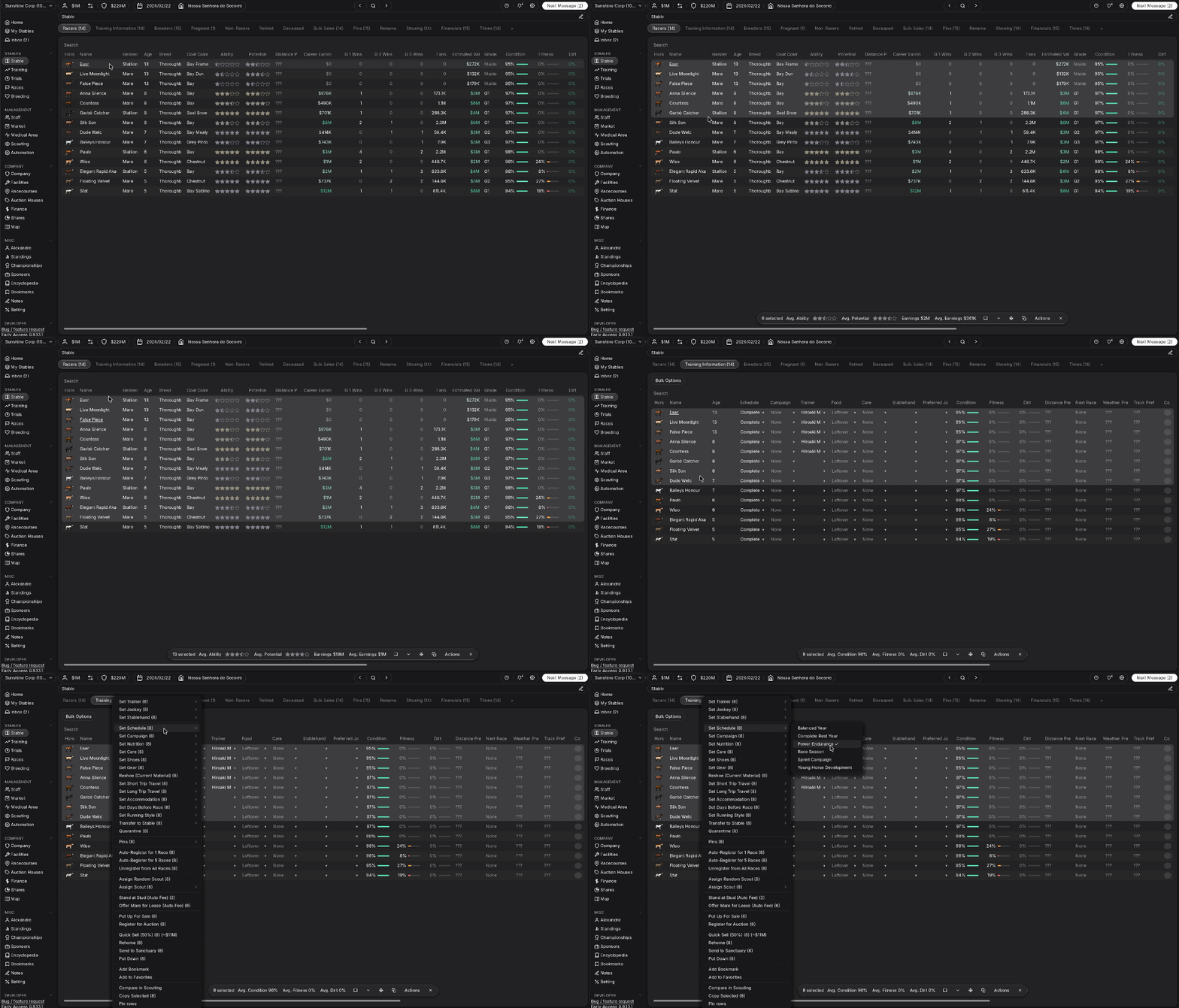
Drag selection, bulk dropdowns and totals in the action bar
A round of consolidation went through the navigation. Racecourse and auction house pages merged into a single venue page, the medical page tabs were restructured and combined, the training tab folded into the staff page with the staff table on the overview, and the finance graph pages merged together. The shares page left the sidebar entirely, with the market moving to the share tab on a person and the equity controls such as IPO and dividends moving to the shares tab on a company. The three breeding contract tabs became one, and pins were renamed to groups since that describes them better.
The interface got a general pass alongside this. The settings page was reorganised into groups with some categories merged, tooltips have their own speed setting or can be switched off, and the sidebar icons were redrawn to be simpler. Scrollbars look consistent, graphs have a gradient fill, tables shade negative values as well, contrast was raised across the theme colours, progress bars match the ones used in tables, and sidebar, tab and toggle clicks are animated. The theme editor itself was simplified to around eight main colours with a live preview, with everything else still reachable under advanced options, and the save and load screens follow the game theme. The person and horse builders were restyled, and the in game character editor now resembles the one at the start of a game, with a colour wheel for skin, hair and clothes. More emails show a visual card for the entity they concern, with a pill marking anything player related the same way tables do.
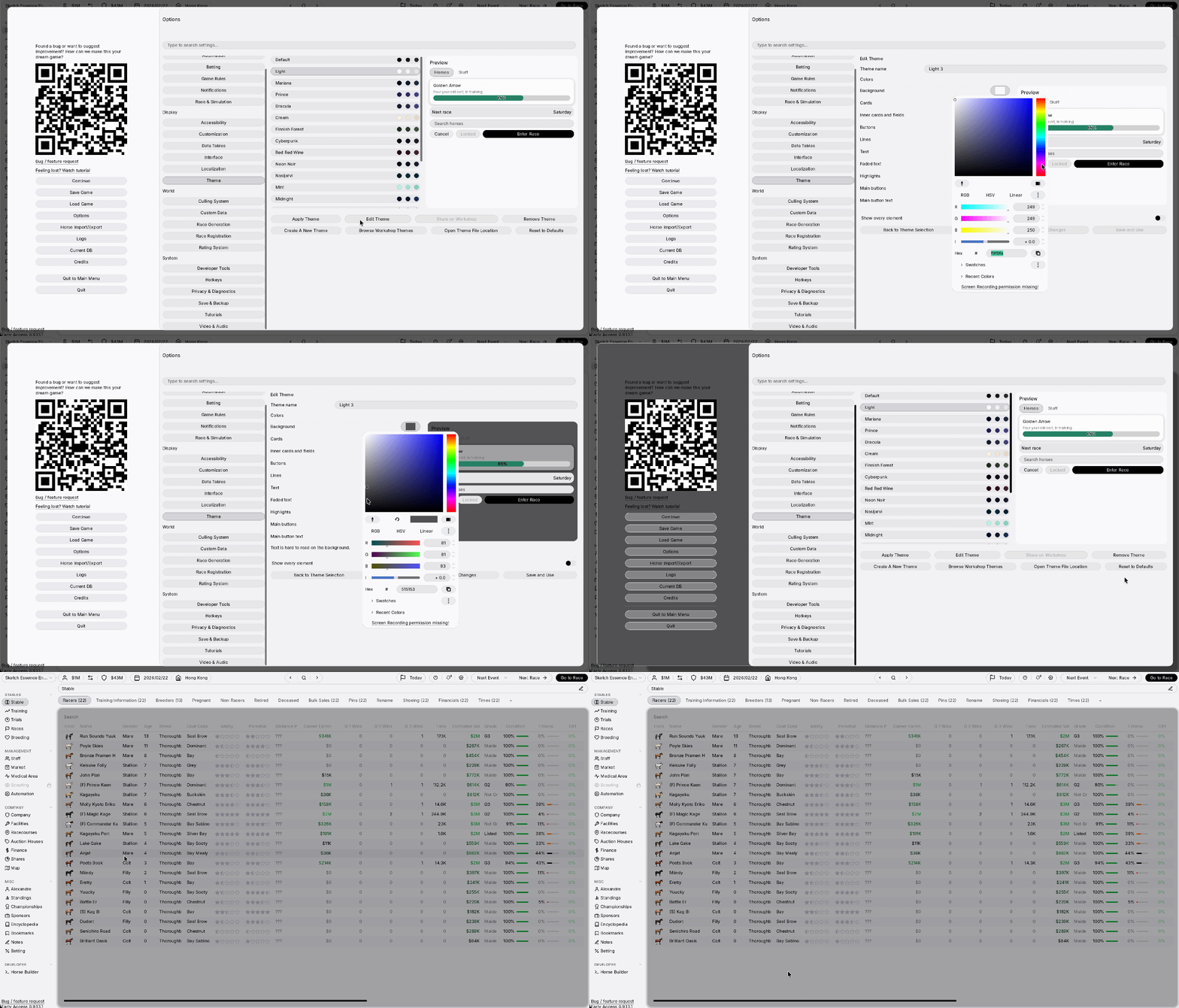
The simplified theme editor with live preview
The top bar does more than report numbers. Clicking either the personal or the stable balance opens the finance page, hovering over one shows a graph of the last twelve months, and clicking the bars in the finance overview drills into them. The inbox can be filtered down to unread messages or to the ones waiting on a reply, deleting an email moves to the next unread one, and the assistant manager’s notifications on the home screen carry action buttons so the obvious response can be given without going anywhere.

Hovering the balance shows the last twelve months
Season campaigns can be assigned to horses to control automatic registration or target specific races, and they can be chained so one leads into the next. Campaigns can be imported, exported and published to the Steam Workshop, alongside concepts, recurring races, auctions, themes and race replays. Pre-made campaigns ship with the game, including profiles for things like dirt only racing, and campaign targets take priority over clashing races. There is also an in game Workshop browser, so subscribing to what others have made does not require leaving the game.
A talk function handles dealing with NPCs, reachable from the context menu or the interact screen, covering things like asking someone for money. NPCs sometimes start these conversations themselves, they respond more personally depending on their traits, and what is said varies depending on whether the other person is a lover, family or a stranger. Every interaction is also available from the interact page on a person, and interactions can be run in bulk through the action menu.
Bulk work in general got much faster. Context menu actions cover quarantine, quick sell, rehome, sanctuary, putting a horse down, raises, bonuses and staff autobalancing, stables and facilities can be bought in bulk, horses can be exported and imported in batches with duplicate detection, and the data browser can change a value across many selected rows at once. Right clicking any entity link, such as one in an email, opens the action menu as well. The family tree has quick filters and a table view, and the household table has dropdowns and bulk actions of its own.
More of the routine can be handled automatically. A recommended automation button sets everything up in one go for anyone who would rather not read through the options. Some emails carry an always accept button, ride offers can be auto accepted against criteria, ceremony emails can be given a standing response, a buy mode can be chosen for horses, and the game can be set to stop at any email or only at ones for a chosen stable. Reminders can be attached to upcoming races and auctions on the home screen, there is an autosave toggle for after each race, and owning several stables opens a dedicated overview page in the sidebar.
Smaller things round it out. The folder for save files can be chosen in settings, new games pick metric or imperial based on locale, and bugs can be reported from inside the game with a screenshot, a priority and an optional email address so we can come back with a question or a fix that already exists. Human writers have also started going through the inbox to reformat emails and make them more interesting, with some new ones appearing along the way.
Performance
Saving was the biggest single win. A change to the compression level took a large save from around a minute at 60MB down to roughly two seconds at 70MB, which is a trade we are happy to make. Saves are around 10% smaller on top of that, saving itself got faster again, and preparing horse animations for a race takes about 80% less time.
Large worlds got a lot of attention. The interface handles worlds up to five times Mammoth size far more smoothly, world generation is faster, and the world map uses less memory. Migrations run with indexes, and default world sizes were shifted so that what used to be normal plus is now normal, since the old normal was too small to fill races properly. World start horse counts were rebalanced on top of that, which roughly halved simulation time for games played in Europe. Extremely large saves are much faster now, and the tables including the finder pages hold up on very large data sets.
Day simulation is faster, the frame rate while simulating is better, the inbox handles very large saves better, and the social tab and top bar both load quicker on mature saves. Weather effects in the live race were made more efficient, and crashes on low memory machines were addressed. The new race engine is a little slower to simulate than its predecessor, and that is where our optimisation work goes next. We also added optional telemetry, which helps us find simulation bottlenecks and see which parts of the game people actually engage with.

Simulating a week
Community Guide
Stratatines has been making guides for the game, and there is plenty more great content on the way. We really like what Stratatines is doing and are happy to share it here. Whether you are new to the game or want to get more out of it, beginning with the Beginner’s Guide below.
https://www.youtube.com/watch?v=cpHDxZynrpk
Soundtrack
The Horse Racing Manager soundtrack is out on Steam. It holds nine tracks written by our musician, and all proceeds from it go directly to them rather than to the studio. The music in the game is their work, so this felt like the right way to handle it.
https://store.steampowered.com/app/5136430/Horse_Racing_Manager_Soundtrack/
What’s Next
We are now around a month from launch, so new ideas are under a feature freeze. The work left before release centres on fine tuning the new race engine, steeplechase, more gear customisation and general balancing, along with some small surprises we have been cooking. Those are the open areas, and the survey responses are feeding directly into where the balancing effort goes.
Everything else from here is polish and fixes in the run up to 4th of December.
Discord Server
We have member count of over 1900 already. If you have suggestions, ideas or something else you want to talk about, it’s a great platform and an easy way to reach us. Join the server here!
Development is ongoing, and we will keep you updated on our progress. We are continuously working to enhance Horse Racing Manager, and your feedback is invaluable. Our goal is to make this franchise the most realistic horse racing simulator in the world. Your support is crucial for us and greatly appreciated.